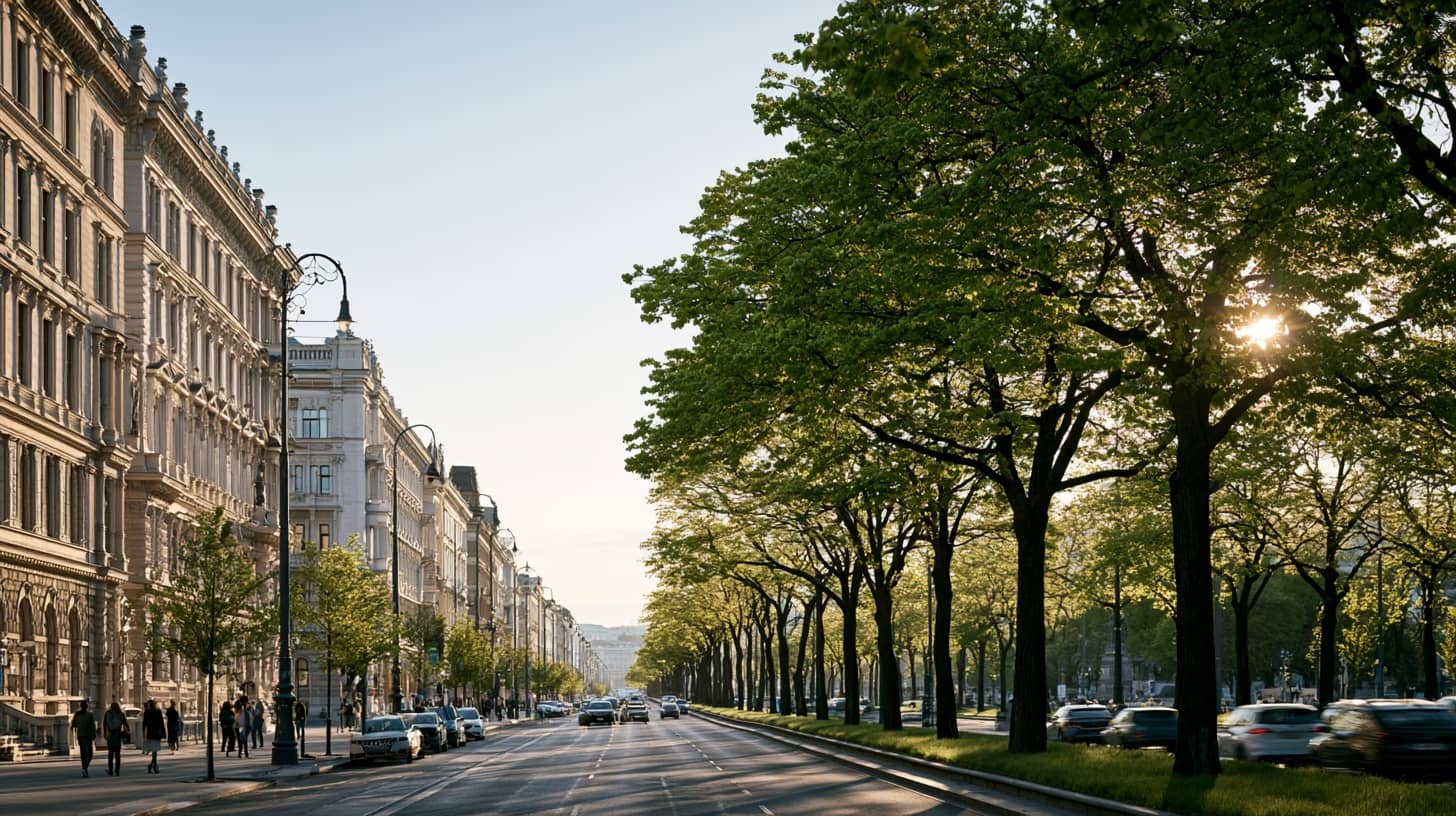
The mistake is to wait for summer. By then, the benches are fuller, the queues longer, and Vienna’s tidy pleasures start competing with heat, tour groups, and the general fatigue of peak-season travel. Come earlier, and the city is easier to read: café terraces open without ceremony, museum days feel sensible rather than strategic, and the parks are animated without tipping into chaos.
This is when Vienna’s personality comes through most clearly. The grandeur is still there, of course, but it feels less like a performance. You can move between opera-house façades, quiet courtyards, and serious coffee counters without needing a spreadsheet or a saintly amount of patience.
Why spring suits Vienna so well
Before summer takes over, the city runs on a more humane rhythm. Locals are outside, but not yet in holiday mode. The light lands softly on the Ringstrasse, and even the broad, formal avenues seem to relax a little.
That matters in Vienna, where scale can be part of the charm and part of the test. In spring, I’d rather walk between landmarks than assemble a heroic itinerary. The city rewards that slower pace: one museum, one coffee, one long detour through a park or side street is enough for a day that still feels full.
The season also makes decisions easier. If you are sensitive to crowds, or simply dislike spending your trip negotiating the volume of other people’s plans, spring keeps the city legible. You can still book ahead for major museums or performances, but the whole visit feels less scheduled into submission.
Start where the city is most itself
I’d begin in the Innere Stadt, but not in the spirit of checking monuments off a list. This is where Vienna gives you the classic frame: the Hofburg, St. Stephen’s Cathedral, the opera, and those long, polished streets that make you walk a little straighter whether you want to or not.
The trick is to keep moving. Circle the Albertina, cross toward the State Opera, then pause for a coffee before the city starts to feel ceremonial. Even the most polished stretches of central Vienna have small interruptions that soften the formality: a newspaper kiosk, a narrow passage, a pastry shop, a tram sliding through like it knows exactly where it belongs.
If you want a useful orientation stop, the city’s own tourism office is worth a quick look for current exhibitions and events. After that, stop consulting your phone for a while. Vienna is best when it is partly planned and partly allowed to unfold.
Cafés are the real spring itinerary
Vienna’s café culture is not an accessory to the trip. It is the trip, or at least the part that makes everything else manageable. In spring, when the weather swings between brisk and coaxing, cafés become the city’s most reliable infrastructure.
Go for the old names and the straightforward habits. Café Central is the obvious classic, though it works best if you arrive with patience and a sense of occasion. Café Sperl feels more lived-in, and the atmosphere there is less about spectacle than continuity. If you want something that pairs well with a wandering afternoon, the city’s café culture rewards the long sit, the second coffee, and the cake you tell yourself is a strategic snack.
If this is the part of Vienna you most want to lean into, the café scene in Vienna is easiest to enjoy when the weather is still undecided. You get the pleasure of being indoors without feeling trapped, and the rare satisfaction of making a city feel more personal simply by slowing down enough to notice what people are reading.
Museums before the peak-season drift
Vienna has no shortage of serious museums, but spring is when they feel especially well timed. You can move from one collection to another without the summer sense of urgency that turns culture into damage control, especially if you let a slower afternoon in the museums do the work. The city’s museums are not there to rescue a rainy day; they are part of why the day works in the first place.
The Kunsthistorisches Museum is the obvious heavyweight, and for good reason. Its collection is rich enough to justify a long visit, while the building itself is one of the city’s great statements in stone, marble, and confident symmetry. The Leopold Museum gives you a different tempo, with Austrian modern art and a sharper line on the city’s artistic past.
For something more contemporary, the mumok has the advantage of keeping the conversation current. If you like a museum day that also feels like a walk through design, the MuseumsQuartier is a practical base, since it lets you drift between institutions, courtyards, and a café break without overplanning the route.
Walk the imperial city, then escape it a little
The best spring routes in Vienna are the ones that let imperial architecture and open air sit side by side. Around the Ringstrasse, the city’s grand public buildings give you scale and structure, but the gardens and open squares keep the atmosphere from becoming static.
Schönbrunn is the obvious escape valve. The palace can draw a crowd in any season, but in spring the grounds still feel spacious enough to enjoy properly. I’d treat the interior and the gardens as separate visits if time allows, because it is the outdoor part that changes the mood of the day. You are no longer just looking at Habsburg ambition; you are walking through it.

The Belvedere offers a different combination of formal landscaping and art, with the added pleasure of seeing the city’s rooftops stretch out beyond the palace grounds. It is one of the places where Vienna’s seriousness becomes almost playful. The buildings are highly composed, but the walk there and back gives you air, perspective, and a reason to keep your pace moderate.
Neighborhoods that make the city feel current
Once the center starts to feel too polished, I head outward. Vienna is full of districts that complicate the postcard version without rejecting it entirely, and spring is the right time to see that contrast clearly.
Neubau is a good place to start if you like independent shops, design stores, and cafés that look as if they were arranged by someone with a strong opinion about chairs. The streets around the MuseumsQuartier spill into a neighborhood that feels creative without trying too hard, which is usually a good sign. You can spend an afternoon here without a strict plan and still come away with a sense of how people actually move through the city.

Across the river, Leopoldstadt has a looser, more lived-in energy. The walk toward the Prater is especially pleasant when the weather tips warm but not yet hot. It is one of those parts of Vienna that reminds you the city is not only about formality; it also knows how to be expansive, practical, and a little informal when it wants to be.
If you want a neighborhood that feels especially good in spring, Wieden gives you a compact, walkable mix of local life, small cafés, and easy access back toward the center. It is not trying to impress you. That is exactly why it works.
Food when you want more than coffee and cake
Eventually, café snacks stop being enough, even in Vienna. Spring is when I start paying more attention to lunch rather than waiting for dinner to save the day. The city’s food culture is not loud, but it is thoughtful, and that is often better.
Try a proper Austrian lunch rather than chasing novelty. Tafelspitz, schnitzel, dumplings, and seasonal plates in traditional dining rooms have the benefit of feeling grounded rather than theatrical. Naschmarkt is still useful for grazing and browsing, though I would treat it as a place to sample, not to define the city by. It is at its best when you wander through with no expectation that every stall needs to change your life.
If you want a slightly more contemporary read on Vienna’s eating habits, look for kitchens that combine local produce with a lighter hand. Spring menus often do the work for you: asparagus, herbs, greens, and less of the heavy winter logic that can make dining in central Europe feel like an endurance test.
What I would actually do over two or three days
If I had a long weekend in Vienna before summer, I would keep it deliberately simple. Day one would be central Vienna and one major museum, with a long café break and an evening walk around the opera and Graben. Day two would push outward to Schönbrunn or Belvedere, with enough time left for a neighborhood wander in Neubau or Wieden.
On a third day, I would choose between the Prater, a second museum, or a more decorative route through the historic center. The point is not to see everything. It is to leave room for what the city does best: calm transitions, elegant interiors, and enough public space that you never feel trapped in a single script.
This is also where Vienna’s seasonal advantage becomes practical rather than poetic. Before summer, you can still pivot if rain shows up, or if you simply decide that a long lunch is a better use of time than a crowded attraction. That flexibility is a luxury, and Vienna handles it well.
Practical tips for a better spring visit
The weather can change quickly, so pack for layers rather than optimism. A light coat is more useful here than a dramatic spring outfit that works only under ideal conditions. Comfortable shoes matter too, because Vienna encourages walking in a way that is civilized on the surface and quietly demanding underneath.
- Book major museums ahead if you are visiting on a weekend or around holidays.
- Keep at least one unstructured afternoon for cafés or a neighborhood walk.
- Use trams and the U-Bahn to save your feet between larger sights.
- Choose indoor backup plans that you would actually enjoy, not just endure.
- Carry some cash, though cards are widely used in many places.
For transit, the city’s public transport system is unusually easy to trust. If you want the official details, the Wiener Linien site is the place to check routes, tickets, and disruptions before you go out. It is a small piece of prep that saves a surprising amount of time later.
One more thing: avoid overfilling the day. Vienna can handle ambition, but it tends to reward composure more than conquest. A good spring visit here is not about rushing to the next headline sight. It is about noticing how the city changes when summer is still a little way off, and letting that quieter version set the pace.
Why this window matters
Every city has a season when it is easiest to understand. For Vienna, that season comes just before the summer break opens everything up and complicates the rhythm. The cafés are still generous, the parks are inviting, and the cultural calendar has not yet become a test of stamina.
That is why I would choose this moment over the obvious one. You get the architecture, the museums, the coffee, the formal beauty, and the neighborhoods that feel most alive when people are not yet trying to outrun the heat. More importantly, you get Vienna without the pressure to consume it all at once.
And that, for this city, is the right way in. Slow enough to notice the details, practical enough to stay comfortable, and early enough that the best parts still feel available.