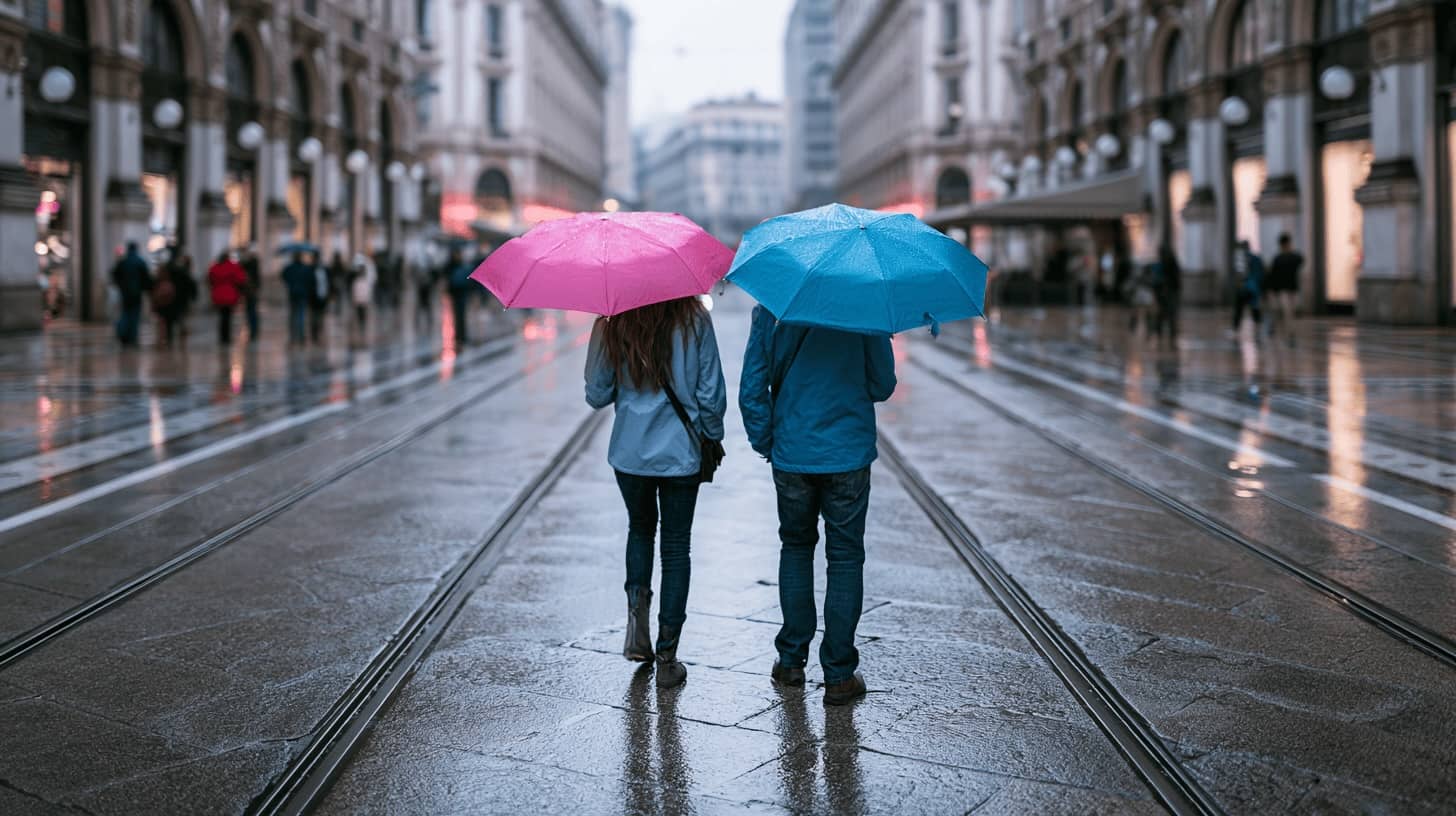
The first sensible thing to do on a wet day in Milan is not to hunt for a heroic umbrella. It is to decide, early, that you will stay central. Once you do, rain becomes a minor inconvenience instead of the day’s organising principle: a short tram ride, a museum entrance, a covered arcade, a café with room to wait out the worst of it.
That matters here more than in many European cities because Milan’s best parts are arranged in compact, walkable segments. The Duomo, Galleria Vittorio Emanuele II, Museo del Novecento, and the streets around Via Dante and Corso di Porta Ticinese sit close enough together to let you change plans without changing districts. If the weather is kind, you can wander. If it is not, you can reroute without losing momentum.
Why central Milan makes bad weather easier
Rain in Milan rarely means retreating indoors for the entire day. It usually means choosing your crossings carefully and letting the city’s central core do some of the work. Here, porticoes, museum entrances, compact streets, and a tram network that is often more useful than a taxi in bad weather all make the day easier to manage.
Base yourself near Piazza del Duomo, Cordusio, Via Dante, or the stretch between Via Larga and Largo Augusto, and Milan begins to behave in a more accommodating way. You are close to the main sights, close to places to eat, and close to a tram if the rain grows heavier. You are not planning a commute; you are planning a sequence.
There is also the question of congestion. When the weather turns, everyone tends to make the same obvious choices at the same obvious moment. A central base gives you room to move earlier, later, or simply in a different direction. That flexibility matters more than it sounds. In rain, avoiding a long, exposed transfer is often the difference between a day that feels orderly and one that feels like a negotiation.
A central morning, without the scramble
Start near the Duomo rather than far from it. In this part of the city, breakfast is best treated as a practical opening move: something close, quick, and on the way. GustaMi Bakery (Duomo) keeps you near the piazza, while Café Kitsuné Milano in P.za Cordusio gives the morning a more polished pause before the weather closes in again.

If you prefer a straightforward Milanese start, Caffè Napoli Giardino suits a wet morning in the centre. It is direct, central, and close enough to the day’s first stop that you do not have to build an elaborate route around it. Caffè Napoli Augusto serves the same purpose if your hotel sits on the eastern side of the core and you want to move toward the museums without detouring.
The point is not to turn breakfast into a survey of the city. It is to avoid beginning the day at the edge of Milan and then travelling inward through drizzle with damp shoes and no clear plan. Central Milan rewards a short walk and a warm doorway more than a heroic search for pastry.
Where to spend the rainy middle of the day
Museo del Novecento is the obvious starting point, with Leonardo3 in the Galleria as a second stop if you want to stay compact. These are close enough together that you do not need to think about the weather between them; you only need to decide which door to open next.
Museo del Novecento is especially useful because it sits on the square itself. The transition from outside to inside is minimal, and the position makes it one of the cleanest responses to a grey day in the centre. If you want a different tempo, Leonardo3 in the Galleria offers a compact, invention-minded stop without pushing you out of the historic core. Both work because they let you stay in the middle of the city instead of scattering yourself across it.

For a slower afternoon, the Civic Archaeological Museum is worth the deliberate detour. It is not far from the centre, but it feels less exposed than the obvious Duomo circuit and gives you a more measured indoor hour when the weather begins to thin the streets. If you dislike feeling directed by the rain, this is a good place to recover your pace.
A useful lunch window, not a detour
Wet weather is often when people make the mistake of scattering themselves across the city for lunch. In central Milan, that is unnecessary. Choose something that sits on or just off your route, and keep the day compact.
Panzerotti Luini is the obvious reference point for a reason: it is central, efficient, and easy to fold into a museum day without adding logistics. If the queue is long, treat that as a signal to move on rather than wait heroically in the rain. Marchesi 1824 is another sensible stop, especially if your route leans west toward Cordusio and you want something quieter than the most obvious tourist stretch.
If you prefer a proper indoor table, Caffè Milano is useful in exactly the way a rainy-day café should be. It is central without being theatrical, and the indoor seating gives you enough time to let the weather pass without losing the shape of the day. The street itself keeps you close to the Duomo and the main museum circuit, which is the whole advantage.
In this part of Milan, the café stop is less a culinary detour than a piece of travel logic. In rain, the right table near Via Dante or Cordusio is not about lingering for its own sake. It is about keeping the day smooth and walkable.
Walks that still work when the sky does not
Some Milan walks are better in rain than in sun because the city’s surfaces and thresholds become more legible. The most obvious example is the small triangle between the Duomo, Galleria Vittorio Emanuele II, and Via Dante. Covered passages matter here, as do short crossings. You can move from one landmark to another without undertaking a long, exposed street march.
If the afternoon stays grey, head toward Brera Botanical Garden for a quieter change of pace, then continue through the surrounding streets without forcing a grand itinerary. The garden is modest rather than showy, which is part of its usefulness. It gives you a pause without asking for much, and Brera itself lets you keep moving through elegant streets without feeling pushed toward transport.
Giardini Perego and the Giardino della Villa Belgiojoso Bonaparte are both worth knowing for the same reason. They sit in that more composed part of central Milan where a short walk between trees, façades, and museum entrances can reset a day. On a wet afternoon, you are not looking for a park to picnic in. You are looking for a place where twenty minutes outside feels intentional rather than weather-driven.
A short practical note on getting around
Use the tram whenever it helps you avoid unnecessary transfers. Milan’s central network is often more forgiving than a chain of Metro changes when the pavement is slick and everyone is moving a little more slowly. A hotel near the Duomo, Cordusio, or Via Palestro saves time not because the city is tiny, but because it keeps the decisions short.

If you are booking with weather in mind, the most sensible location is usually the one that lets you walk to at least one museum, one bakery, and one tram stop without thinking about it. That sounds obvious until the rain starts. Then it becomes the whole point.
It also helps to choose a base with easy access to the centre rather than an elegant address that requires a long commute. Milan’s central streets are not difficult, but they are better enjoyed in pieces. A hotel near Piazza del Duomo or between Cordusio and Largo Augusto lets you step back indoors whenever you need to, which is exactly the advantage a rainy city break should offer.
If you want a second indoor option
When the obvious museums have already filled your afternoon, keep one more indoor stop in reserve rather than pushing out to the outskirts. Museo Diocesano is a sensible southern alternative if your route has already moved toward the Ticinese side of the centre. It keeps you in the city without turning the day into a transport exercise.
Another option, if you prefer a more encyclopedic detour, is the Milan Natural History Museum. That is a slightly longer central move, but still walkable if your base sits well. It works best for travellers who want a proper indoor hour and do not need every stop to feel fashionable.
For a more intimate, slightly less obvious choice, Museo d’Arte e Scienza fits a wet day with less crowd pressure than the headline names. It is one of those places that rewards the decision to stay central rather than racing across town in search of novelty.
How the day should end
By late afternoon, the right move is not to “make the most” of the weather. It is to protect the part of the day that still feels easy. That may mean one last pass through the Galleria, a final coffee near Cordusio, or simply a slower return along Via Dante with the tram in view and the museums behind you.
If the rain keeps falling, finish with something close to your hotel and not something theatrical. A central Milan base gives you that choice. You can end the day under the arcade by the Duomo, beside a bakery counter near Via Larga, or on a tram heading back through the centre while the city stays dry enough indoors to feel well judged.
On a wet day, I would rather be between Museo del Novecento and a tram stop than anywhere grander and more complicated. In Milan, that is usually enough.