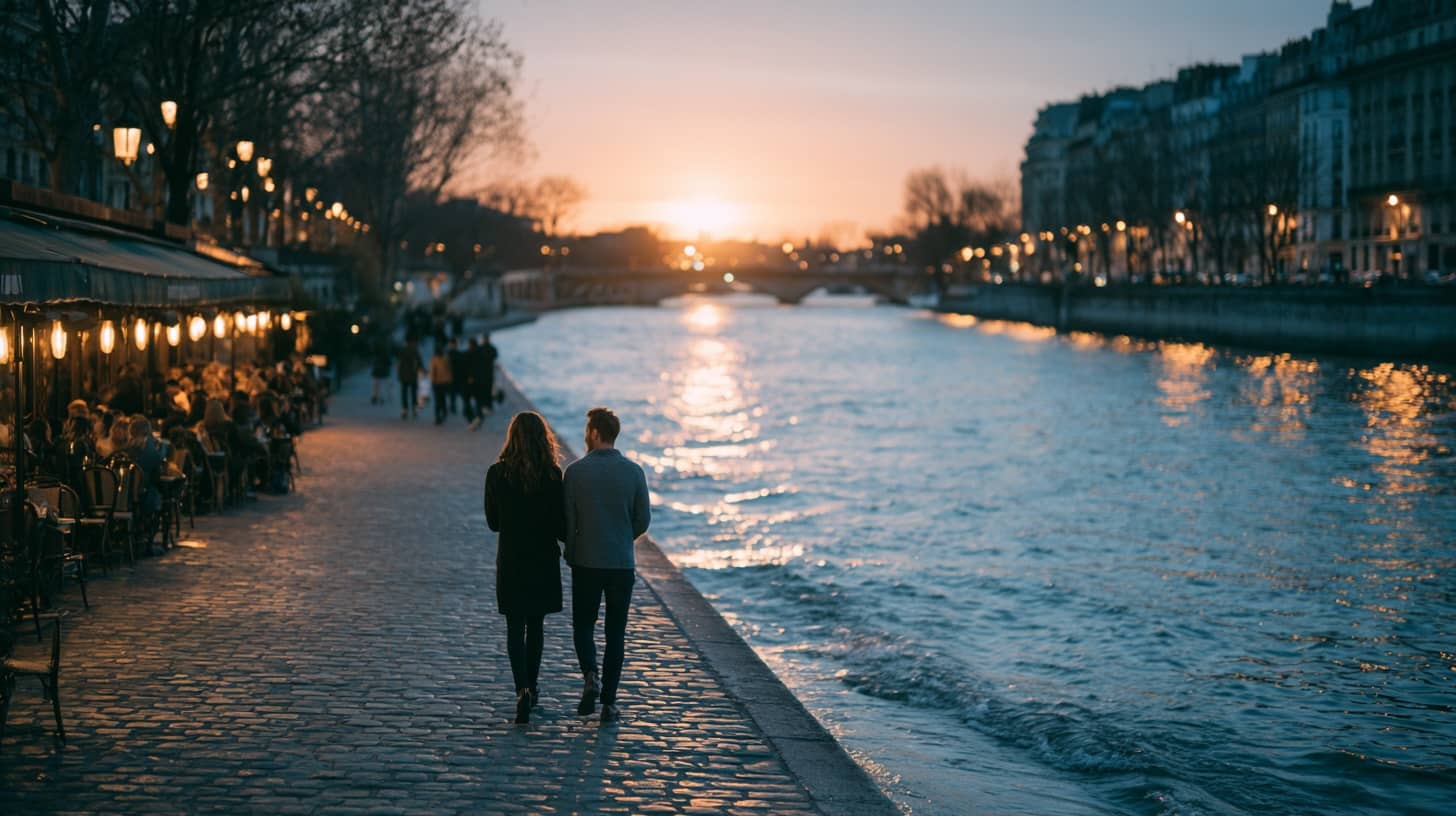
The worst mistake in Paris after dark is trying to do too much at once. One elaborate dinner, one famous bar, one district you have “heard about” and suddenly the night feels like homework. Better to pick a neighbourhood that can carry the evening on its own, with a good table, a decent stretch of pavement, and somewhere to stand around after dinner without feeling pushed into a performance.
That usually means letting the light fade in one place and staying there. In the Marais, around Rue de Sévigné and Rue Vieille du Temple, the streets keep enough life for a late wander without asking you to chase it. In Saint-Germain, the night leans more polished, with dining rooms and bar counters that suit conversation rather than noise. And if you want something with a little more lift, Belleville gives you a skyline and a crowd that knows how to linger. The point is not to “do Paris nightlife.” The point is to choose the version of evening that still leaves room for walking home.
Start with dinner that doesn’t rush the rest of the night
For a sane evening, dinner should be the anchor, not the whole event. A place like Brasserie Bellanger in the 10th works because it understands the basic Paris rule: if people are going to arrive late, they still need somewhere with enough room, enough sound, and enough stamina to absorb the hour. If you want a more polished room, Aux Prés Cyril Lignac in Saint-Germain is a better match for a night that will end with a drink rather than a big table of repeated orders.
What you are looking for is not novelty but ease. Large brasserie-style rooms such as Bofinger near Bastille or Brasserie des Prés in the 6th let you stretch dinner into the evening without your shoulders going up around your ears. They are useful precisely because they are not trying to make a theatre of your meal. If you are in the Marais, the cultural side of Paris also happens to be a sensible place to think about dinner first and drinks second, because the surrounding streets stay walkable once the museums and galleries have closed.

If you prefer a neighbourhood with a bit more edge to the room, Bastille is still one of the better bets for people who like dinner to spill into conversation without a dress code hanging over it. Bastille Tintin, on Rue de Lappe, sits in that category of place that can act as a practical start to the night rather than a grand declaration. That matters more than people admit. The best evenings are often the least ambitious ones.
Choose a bar that can be the last stop, not the first disaster
After dinner, Paris rewards bars that know how to keep the volume of the room under control. Bar Hemingway at the Ritz is the opposite of casual, of course, but it earns its reputation because it is built for a contained, almost ceremonial kind of drink. You go there if you want a pause in the evening, not momentum. It works best as a deliberate choice, especially if the rest of the night has been kept simple.
For something less formal, Candelaria in the Marais has the right kind of small-scale energy for a night that should stay under control. It is the sort of bar people choose when they want the night to continue without having to announce that it is continuing. Bar Nouveau in the 3rd also fits that brief: contemporary, compact, and useful when the group wants a drink without committing to a whole scene around it.

There is also a case for places that sit somewhere between restaurant and bar. Chouchou near Châtelet can work for that in-between mood, especially if you like your evening with a little interior bustle and a space that feels ready for lingering without becoming a late-night trap. Beaux Parleurs, on Rue Lepic in Montmartre, is similar in spirit: not fussy, not anonymous, and useful if you want to keep the night sociable without pushing it into club territory.
Walk between neighbourhoods, not across the city
The cleanest Paris evening is often the one that stays on foot for as long as possible. In the Marais, a route from the Carnavalet Museum area to Rue des Rosiers and then out toward Rue Vieille du Temple gives you enough movement to reset after dinner, but not so much that you lose the thread of the night. The streets here still carry the right kind of low evening noise: people finishing meals, taxis easing around corners, voices coming out of doorways rather than spilling across entire blocks.
If you want a more classic evening walk, the stretch around the Seine is obvious for a reason, but it only works if you use it selectively. The Champ de Mars has an open, almost theatrical relationship to the tower after dark, and it is most persuasive when you want one big visual moment before heading elsewhere. Do not treat it as a full evening plan. Treat it as a pause between dinner and your next room.
Belleville gives you a different sort of movement. The climb toward the Belvédère de Belleville is worth making if you like ending the night with a view that does not feel over-packaged. It is particularly good when you want your evening to have a sense of place without being flattened into postcard Paris. The surrounding streets have enough ordinary life left in them that the walk itself feels useful, not decorative.
Use the riverfront only when you want the city to slow down
Some evenings call for water and a longer exhale. The canal edge around Quai de Jemmapes, especially if you start from the northern side of the 10th, is one of the few parts of central Paris where a night walk can still feel loose rather than ceremonial. Billy Mango sits on that quay, and while it is a restaurant rather than a casual stop, the location makes sense for anyone who wants dinner with a longer after-dinner drift nearby.
The Seine is better when you are not trying to “see everything.” Walk a short section, pick your bridge, and stop. That advice sounds obvious until you watch travellers turn a simple riverfront into a mile-long obligations list. The most useful evening approach is often to commit to one bank, one bridge, one direction. Leave the rest for another night.
If your idea of a good night includes a quieter end rather than a louder beginning, the riverfront can be your final move rather than your opener. After a late meal in the 1st or 4th, the walk by the water gives enough air to settle the night without forcing it to extend indefinitely. That is a small but important distinction. Not every evening needs escalation.
Where to go when the weather stops being cooperative
Rain changes the whole calculation, and in Paris it usually means choosing interiors with enough character to keep you happy for a while. Bar Hemingway is an obvious shelter if you are in the centre and want a room that can absorb a damp, dressier crowd. Candelaria does the same thing in the Marais, but with a more compact, less ceremonial feel.
If you want to stay with dinner and avoid the wet streets altogether, Brasserie Bellanger and Brasserie des Prés both make practical sense because they are built for staying put. That matters more on a rainy evening than any perfectly timed reservation. The point is to avoid the dead zone between “finished eating” and “not yet ready to head home,” which is where bad nights tend to begin.
For a rain-proof walk that still feels like an evening out, the route around Carnavalet Museum and its surrounding streets is useful because it keeps you in a dense, readable part of the Marais. The museum itself is not the after-dark attraction here; the neighbourhood around it is. Even when you are not going in, the area gives you enough built fabric, café light, and doorways opening and closing to make the night feel inhabited.
A better three-stop evening than a heroic one
If you want one uncomplicated plan, make it this: dinner in Saint-Germain, a drink in the Marais, then a short walk home or back to your hotel through streets that still feel alive but not frantic. Aux Prés Cyril Lignac is a strong first stop if you want the meal to feel a little more tailored; Candelaria is a better second stop if you prefer your drink quieter and more intimate. The route between them is less important than the mood shift: polished table, then a room that loosens the shoulders.
If you are staying east, swap the order. Start with Bofinger or Bastille Tintin near Bastille, then move toward Bar Nouveau or Beaux Parleurs depending on whether you want something more tucked away or more conversation-friendly. That whole part of the city works well for travellers who like their night built from blocks rather than from a single marquee venue. It is less about spectacle than about staying in motion without feeling hunted by the next reservation.
And if you only want one thing from the evening, let it be the right ending. A drink under low light at Bar Hemingway, a late table at Brasserie des Prés, or a final look from the Belvédère de Belleville will each produce a different kind of night. The useful question is not where everyone else is going. It is whether you want to leave with your voice still intact.
What to keep in mind before you head out
Paris after dark is easiest when you stop treating it like a race between neighbourhoods. Public transport is still useful, especially if you are moving between districts, but the city gets better when at least one stretch of the night is done on foot. Plan for a dinner district, a drink district, and a walking district; two of those can be the same place if the mood is right.
Book ahead if you care about a specific dining room, especially on Thursday through Saturday, and check the official site for current opening details before you go. That advice is boring in the best way. It keeps the evening from collapsing because a place that looked obviously available turns out to have a different schedule than the one you assumed.
Most importantly, do not over-program the dark. Paris is more persuasive after sunset when you let one room lead to another without insisting that every address be famous. A table that lasts, a bar that does not shout, and a walk that ends with a view or a station entrance are usually enough. On a good night, the last thing you remember is not the trendiest room in town but the clean line of Rue de Sévigné, the hum around Bastille, or the quiet wideness of the walk back from Belleville.