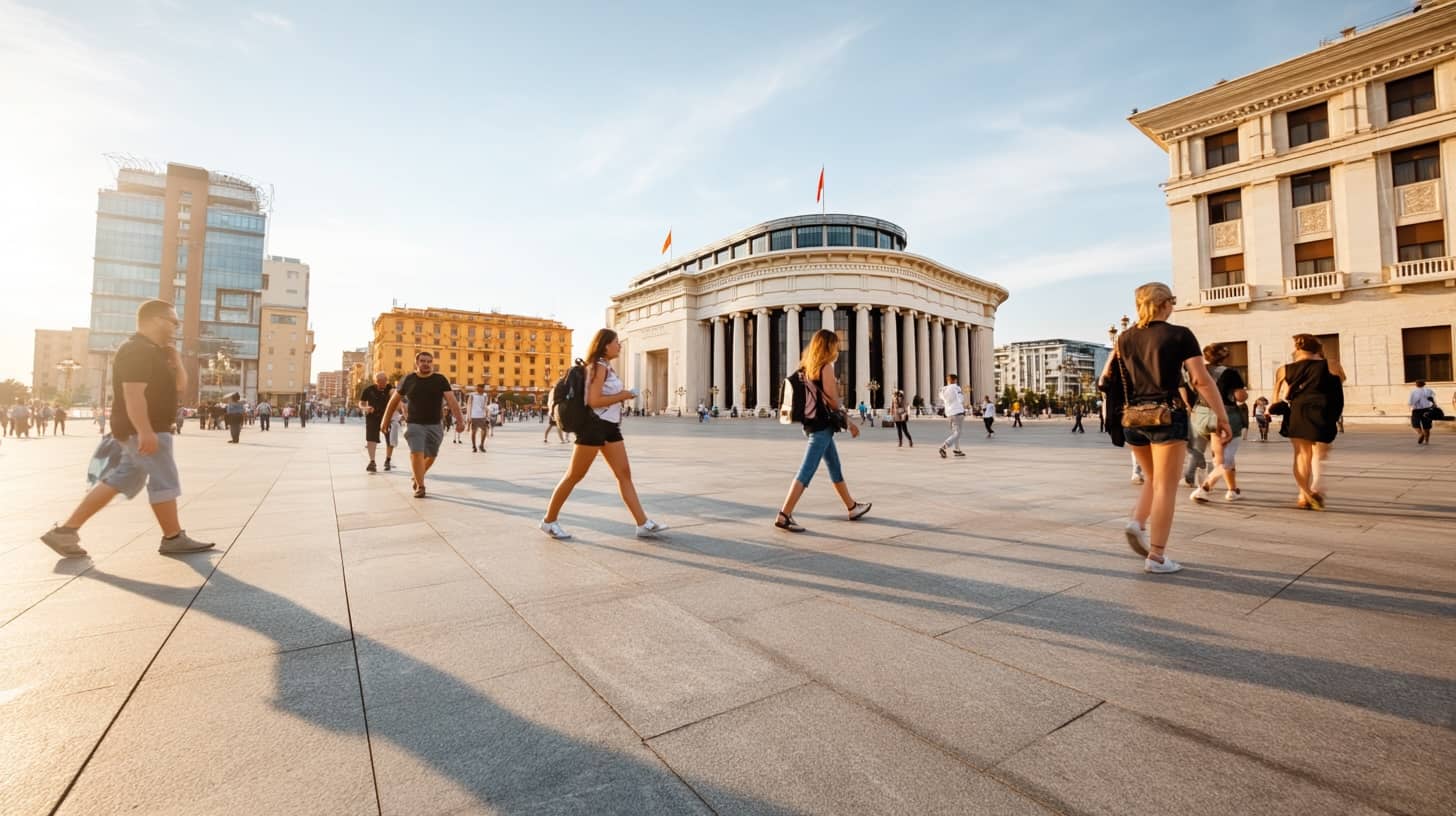
If you want to make sense of Tirana quickly, do one sensible thing: start at Skanderbeg Square and keep walking. The city centre is compact enough to reward curiosity, but busy enough to punish vague wandering without a plan. Around this wide plaza, Albania stages its recent history, its public life, and a good part of its cultural self-image.
That is what makes the square so useful. It is not only a landmark; it is the clearest place to read the city’s layers without needing a map full of pin drops. From here, you can move between museums, religious buildings, brutalist leftovers, cafés, and the pedestrian spine that gives the centre its rhythm.
The square that gives the city its shape
Skanderbeg Square is where Tirana stops being abstract and becomes legible. The space was redesigned into a huge, lightly sloping pedestrian plaza, and it works best as a place to orient yourself before choosing a direction. I like that it is open rather than over-programmed; the scale gives the city room to breathe.
At the centre stands the equestrian statue of Skanderbeg, Albania’s national hero, with the National Historical Museum facing it like a set piece from another era. Around the edges, the square gathers the city’s institutions, from the opera house to government buildings and cultural venues. It is formal, but not sterile. People cross it, pause on the steps, and treat it as part civic room, part stage.
The paving itself matters more than you might expect. Different stones sourced from across Albania were used to create a subtle patchwork underfoot, a quiet reminder that the square is meant to represent the country rather than just the capital. It is a rare piece of urban design that asks you to slow down and notice the ground.
What to see first without overplanning it
The most obvious stop is the National Historical Museum, which sits directly on the square and gives you the broadest possible sweep of Albanian history. Its façade is impossible to miss, and the mosaic above the entrance is one of the city’s most recognisable images. Inside, the collection is wide-ranging enough to help you understand the political and cultural shifts that shaped modern Tirana.
From there, I would continue to the Et’hem Bey Mosque, one of the most graceful buildings in the centre. It survived the decades of state atheism and still feels intimate compared with the scale of the square outside. Nearby, the Clock Tower offers a vertical counterpoint, and if you climb it, the city centre suddenly looks more ordered than it does at street level.
For a more contemporary perspective, walk to the National Gallery of Arts if it is on your list and open at the time you are there. Even without going inside, the area around it helps you understand how the city’s official culture sits beside daily life. That mix is one of Tirana’s most interesting qualities: it rarely separates the ceremonial from the ordinary.
Walk the square as a route, not a destination
What works best here is not standing still for long, but moving in small loops. Start at the square, cross toward the ministries, then swing back past the museum and into the pedestrian streets that radiate south and west. In practice, this is the easiest way to get your bearings in the city centre without sacrificing an afternoon to indecision.
The streets leading off the square shift tone quickly. One direction gives you bureaucracy and grand facades; another brings you cafés, bookshops, and the sort of everyday retail that tells you more about a city than any monument. The centre is flat and walkable, which means you can be pleasantly opportunistic, even when you are thinking about what to do after dark. If something catches your eye, you do not need to calculate whether it is worth the detour.
That is also why the square makes sense for a first day in Tirana. You can take in the main landmarks, get coffee twice, and still have enough energy left to drift into the rest of the city rather than choosing between “sightseeing” and “doing nothing.” In a city this compact, the best plan is often a flexible one.
Cafés, terraces, and the politics of a good pause
The centre around Skanderbeg Square is not short on coffee options, which is exactly as it should be. Tirana takes café culture seriously, and the area gives you an easy choice between quick espresso stops and longer sits where people seem perfectly content to let the day slow down. That is useful after museum time, but it is also the main reason to linger in the area at all.
I would look for a terrace or a street-facing table rather than rushing into the first polished interior. The square works best when you watch it from the edge, with office workers, students, and families crossing in different directions. Coffee here is not just a drink; it is a way of staking a small claim on the public realm.
If you want a livelier setting, drift toward the pedestrian stretches leading to Pazari i Ri and the surrounding central blocks, where the pace gets looser and the crowds more local. It is a short enough walk that you can treat it as part of the same outing. Tirana is at its best when one part of the city hands you off neatly to the next.
Architecture tells the story better than a brochure
One reason I keep coming back to this area is that the architecture around Skanderbeg Square is never just decorative. It records political eras in a way that feels almost blunt. You have Ottoman survivals, fascist-era planning, communist remnants, and recent interventions that are trying, not always elegantly, to make the centre more public and less authoritarian.
That contrast is especially visible in the edges of the square. The National Historical Museum is monumental in a distinctly late-20th-century way. The mosque and the Clock Tower bring the older city into view. Then, just beyond, you find stretches of newer development and renovated facades that signal how quickly Tirana is remaking itself. It is a city of edits rather than clean breaks.
If you enjoy architecture, the square is a compact way to read those edits without trekking across the whole city. Notice the proportions, the materials, the wide pedestrian surfaces, and the way the surrounding buildings either support or resist the openness of the plaza. It is the sort of place where the urban design is most interesting when you pay attention to what it is trying to make possible.
Where the centre gets more human
For all the monumental logic of the square, Tirana’s centre becomes more enjoyable when it softens. Head toward the side streets and the atmosphere changes quickly. The scale drops, the façades get more varied, and the city begins to feel less ceremonial and more lived-in. That is usually where I prefer to spend the second half of a morning.
One easy direction is toward the pedestrian axis leading past the government quarter and into the café-filled streets south of the square. Another is toward the newer market and food areas where daily life is much more visible. If you want a neighbourhood feel without leaving the centre, this is the zone to linger in. It is where Tirana starts to talk at normal volume.
This is also a good place to notice how social the city is. People do not disappear indoors when they are done sightseeing; they occupy the pavement, the benches, the low walls, the café terraces. For a capital, it feels refreshingly unguarded. That makes the centre pleasant even when you are not actively “doing” anything.
A practical way to spend half a day here
If I were putting together a useful first route, I would keep it simple. Start at Skanderbeg Square in the morning, when the light is soft and the area still feels spacious. Spend an hour or two alternating between the museum, the mosque, the Clock Tower, and a café stop, then walk outward into the streets that feel most active at that moment.
- Begin with the square itself so you can orient yourself before entering any buildings.
- Choose one major museum rather than trying to tick off every institution nearby.
- Build in a coffee break early, not as a reward after the fact.
- Walk on foot between nearby stops; the centre is compact enough to make this sensible.
- Save the more atmospheric wandering for the edges of the square and the adjacent pedestrian streets.
A small practical note: the heat can be harsher than you expect in the open plaza, especially in summer, so keep some shade in your route. The square is generous, but it is not shy about sunlight. If you are visiting in cooler months, it becomes one of the most comfortable places in the city centre to walk without constantly ducking indoors.
Where to eat near the square without making a meal of the decision
Meals in this part of Tirana work best when they feel unforced. I would not chase a complicated lunch here; the real pleasure is in finding a place that does the basics well and gives you time to look around. There are plenty of restaurants and casual spots within a short walk, and the difference between them is usually atmosphere more than distance.

Look for places serving Albanian staples, grilled dishes, salads, and simple pasta or seafood rather than overcomplicated menus. The centre can attract both polished dining rooms and more casual lunch spots, but in either case the best rule is the same: choose the place with enough local life around it to suggest people actually return.
If you want a food-hall feeling later in the day, head toward the City of Tirana information pages for current public developments and central civic spaces, or simply walk toward the market districts where produce, cafés, and small eateries overlap. The city changes fast, and food in the centre often follows that pace. My advice: keep lunch practical and save the grand decisions for dinner.
Why this area works for slower travel
There are cities where the centre is only a transit point. Tirana is not one of them, and Skanderbeg Square proves it. It is one of those rare urban spaces that can absorb both the rushed first-timer and the more patient traveller who wants to understand the city through repeated walks. You do not need a packed schedule here to feel oriented.
What I appreciate most is that the area gives you enough structure without overdetermining your day. You can do the museum circuit, pause for coffee, sit outside, and then decide whether you want more culture, more food, or simply a longer walk. That flexibility is the real luxury in a city centre. It is much more valuable than a checklist.
If you are in Tirana for more than a day, keep returning to the square at different times. Morning, late afternoon, and evening all change the mood. The light shifts, the crowds thin and gather again, and the same plaza can feel formal, social, and almost relaxed depending on when you pass through. That is a good sign. It means the city is doing something right in public.
The best reason to stay nearby
If you want the simplest possible argument for staying near Skanderbeg Square, here it is: you will move less and notice more. Hotels in the centre put you close to the city’s main cultural sights, but they also keep the ordinary pleasures nearby—coffee, a post-dinner walk, a spontaneous detour past a building you have not yet understood.
This is particularly helpful if you prefer city breaks that do not feel like logistics exercises. You can wake up, cross the square, choose a museum, and still have enough time left to wander without planning a second transport step. For adult travellers who value time over mileage, that is a decent trade.
I would not call the square the whole of Tirana. That would be too neat, and the city is not neat. But if you begin here, you give yourself the best possible chance of understanding how the centre works: politically, visually, and socially. That is usually enough to make the rest of Tirana fall into place.