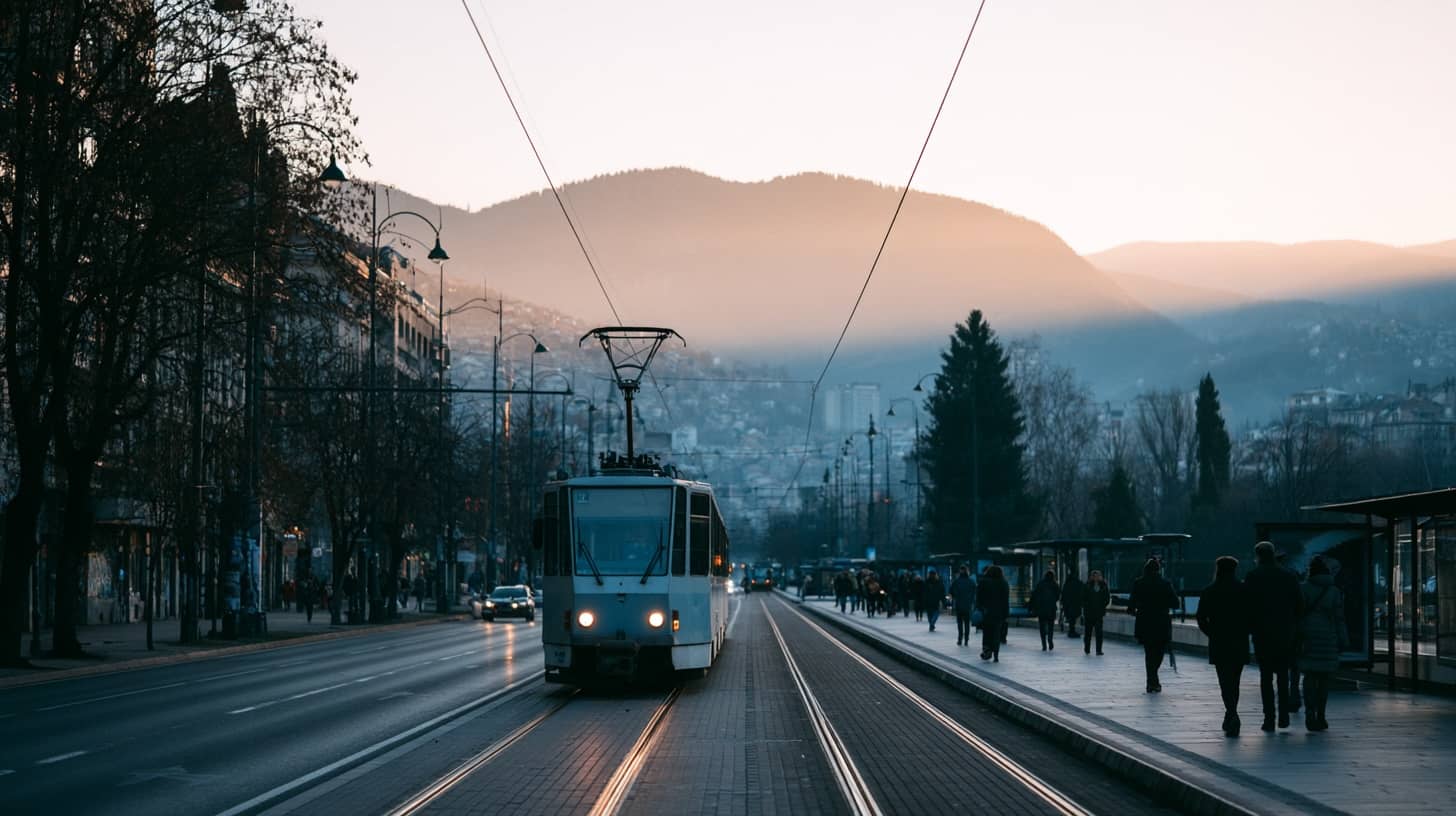
The first mistake is treating Sarajevo as a quick Old Town stopover. That works only until you realise the city becomes far more interesting once you leave the postcard lanes and let the trams, hill roads, and café tables pull you outward.
In shoulder season, that instinct pays off immediately. The air is cooler, the streets are calmer, and the city becomes easier to read: Ottoman courtyards in one direction, Austro-Hungarian façades in another, and apartment blocks that still look busy with daily life in between.
I like Sarajevo most at this time of year because it asks less of you. You do not need to rush the sights, and you do not need to book your day around heat, crowds, or the pressure to “cover” everything. A pair of good walking shoes and a little curiosity will do more here than a rigid checklist.
Why shoulder season suits Sarajevo
Spring and autumn are the city’s most forgiving moods. Cafés still spill onto pavements when the weather cooperates, but the pace softens enough that you can notice details: the chipped enamel signs, the smell of roasted coffee, the way locals choose the sunny side of the street without making a fuss about it.

This is also the season when Sarajevo’s geography starts to make sense. The valley setting means light changes quickly, and the hills matter as much as the centre. On a clear morning, the mountain edges feel close; by late afternoon, the city can look folded into itself, which is part of its charm and part of the logistics. You learn to move with it.
For planning, I would keep things loose. Sarajevo rewards the traveller who leaves room for weather shifts, a longer lunch, or an unplanned detour into a museum. If you want a practical base, where to stay in Sarajevo matters more than it first seems, because the city changes character fast from one neighbourhood to the next.
Start with the tram, not the souvenir lane
The centre is not hard to navigate, but I would not begin with a direct march through the most obvious stretch of Baščaršija. Take the tram first, watch the city pass by, and let Sarajevo introduce itself through ordinary streets. That is usually where the best first impression lives.
Line 3, in particular, is useful for getting your bearings between the old centre and the broader urban fabric. Even if you do not memorise the route, the ride gives you a sense of the city’s scale and how quickly the built environment changes. One stop you have low market streets; a little farther on, wide avenues, modern cafés, and the more formal rhythm of Marijin Dvor.
This is also where I start noticing the city’s architecture in layers rather than as a single style. Sarajevo is not tidy in that way, thankfully. A refined façade can sit beside a repair job that looks held together with optimism, and the effect is more honest than polished.
Museums that make the city legible
If you want Sarajevo to click into focus, spend time indoors. The National Museum of Bosnia and Herzegovina is one of the clearest places to start, partly for its collections and partly because the building itself reminds you that culture here has always had to survive changing politics and priorities. The famous Sarajevo Haggadah is a reason to go, but it should not be the only one.
The Museum of Crimes Against Humanity and Genocide 1992–1995 is harder, and it should be. I would not recommend stacking it into an overfull day; give it the attention it deserves. Sarajevo’s recent history is not background noise, and a shoulder-season trip is a good time to absorb that without the distractions of peak-season chaos.
For something quieter, the Bosnian Cultural Center and the Gazi Husrev-bey Library area can help you understand how the city’s intellectual life has long sat alongside trade, religion, and everyday commerce. You do not need to be a specialist to appreciate the range. You just need to slow down enough to notice that Sarajevo’s public life is layered, not linear.
Old Town, but with better timing
Baščaršija is still worth your time, but I would visit with a strategy. Go early, before the group tours arrive in full force, or late in the day when the light softens and the market streets stop feeling so insistently performative. The core charm is real; it just comes with a few traps for the hurried.

Here, the practical pleasures are simple. Drink coffee at a table that is not trying too hard. Look up at the wooden eaves and metalwork, not just the menu boards. If you want a useful anchor for planning a gentler day, the café rhythm described in the café scene in Sarajevo pairs naturally with a morning in the old centre.
When you are ready to leave the lanes, do not linger out of habit. Sarajevo gets more interesting when you walk just a few blocks away and realise the city refuses to stay in one historical costume. That friction is the point.
Where I would spend time instead: Marijin Dvor and the centre-left stretch
Marijin Dvor is where Sarajevo starts showing its modern face without pretending to be a separate city. It is practical, a little formal, and useful in exactly the way many central neighbourhoods are: hotels, offices, cafés, and enough foot traffic to keep things from feeling staged. It is not cute in the obvious sense, which is often a good sign.
The area around the Parliamentary buildings and the wider avenue network gives you a strong read on post-Ottoman, Austro-Hungarian, and contemporary Sarajevo in one walk. I like it for the contrast alone. The architecture does not compete for your attention so much as it quietly insists that the city’s identity is political, administrative, and lived-in all at once.
If you are choosing a base or dividing your time between neighbourhoods, this is where the practical side of the city becomes obvious. You can move quickly from here to museums, the river, and the centre without feeling trapped inside one tourist corridor. That flexibility matters more than a pretty view from the window.
Cafés, coffee, and the art of sitting still
Sarajevo knows how to do coffee, but not in the oversized, laptop-friendly way many cities advertise. The ritual here is slower and more deliberate. You sit, you wait a little, and you notice that people are not pretending to be in a hurry even when they are headed somewhere.
For a proper introduction, I would make time for a traditional Bosnian coffee served with a rahat lokum on the side. But I would also leave room for the more contemporary cafés around the centre and in newer neighbourhood strips, where the espresso is solid and the interiors feel designed by people who actually care about light, chairs, and noise levels. That alone is worth a detour.
If you want a full morning built around this habit, the article on the café scene in Sarajevo is the right companion. My practical advice is simple: do not over-plan it. Sarajevo cafés are best treated as pauses, not performance.
Food that suits cooler weather and a slower pace
Shoulder season is the right time for Sarajevo’s heavier comforts. You can still eat well in summer, of course, but cooler weather makes the city’s richer plates and warmer flavours more appealing. Think grilled meats, stuffed vegetables, soups, pies, and the sort of breakfast that makes a late start feel entirely justified.
Cevapi remain the obvious move, and yes, they are worth eating properly rather than as a box to tick. Burek is another useful staple, especially when you want something quick and local without entering a long restaurant decision spiral. I also like the city’s habit of making simple food feel serious without becoming fussy about it.
For a nicer lunch, aim for somewhere that understands timing. Sarajevo meals work best when they are not rushed between attractions, because the city’s rhythm is not built for that kind of efficiency. Take the extra half hour. The tram will still be there.
Architecture is the real walking itinerary
One of the best ways to understand Sarajevo is to walk as if you are following a conversation between buildings. The Gazi Husrev-bey Mosque, the Latin Bridge, the Sebilj fountain, and the surrounding Ottoman streets tell one part of the story. The Austro-Hungarian streetscapes around the centre and beyond tell another.
Then there are the rougher transitions: facades with wartime scars, mid-century blocks, newer infill, and repairs that are practical rather than pretty. I find these sections especially useful because they keep the city from becoming a museum piece. Sarajevo is not one of those places where the past is neatly put away after hours.
Do not miss the ordinary buildings either. In shoulder season, when trees thin out and the light sits lower on façades, even a side street can become a lesson in urban layers. If you care about architecture, this is not a city to consume from the main square and leave. Walk more than seems necessary.
When you want a view, earn it gently
Sarajevo’s most famous hill perspectives are worth the effort, but I would avoid treating them as a competition. The Yellow Fortress is the obvious viewpoint for a reason: it gives you a clean read on the valley and the city’s compression between slopes. Go near sunset if you want the light to help you, but do not expect solitude.

If you have more energy, the cable car to Trebević changes the scale completely. The ride itself is part of the appeal, and the mountain air can be a welcome reset after a few days of streets and cafés. The official city tourism information is helpful here, and it is worth checking the current public guidance before you go, especially in shoulder season when weather shifts quickly.
What I would not do is stack every panorama into one day. Pick one good view and let the city keep some of its geography intact for later. That is a better use of your time than collecting lookout points like receipts.
How to spend two or three days without rushing
For a two-day stay, I would keep the centre as the anchor and split the time between one museum-heavy day and one neighbourhood walk with longer café stops. Add Baščaršija early in the morning, then move outward to Marijin Dvor and the nearby institutions. That gives you contrast instead of repetition.
With three days, you can afford more looseness. Add a hill view, a slower lunch, and time for wandering the river edge or sitting in a café long enough to stop behaving like a visitor on a schedule. Sarajevo is not a city that needs efficient coverage; it needs attention.
- Begin early in the centre, before the busiest streets fill up.
- Build one museum into the day rather than trying to fit in three.
- Use trams and short walks instead of over-relying on taxis.
- Choose one viewpoint and enjoy it properly.
- Leave at least one meal unplanned.
Practical notes for shoulder season travellers
Pack layers. Sarajevo can switch from crisp morning to warm afternoon and back again with annoying confidence. A light jacket, comfortable shoes, and something for the occasional rain spell will make the trip more pleasant than any “perfect outfit” ever could.
It also helps to think in zones rather than attractions. The city is manageable on foot in many places, but the hills and the road layout mean that maps can be deceiving. If you are staying outside the centre, check whether the tram or a simple downhill walk is the smarter choice after dark.
Finally, do not underestimate how much time the city gives back when you stop trying to optimise it. Sarajevo in shoulder season is a place for good coffee, sensible pacing, and a little curiosity about how history still sits inside daily life. That combination is more rewarding than any hurried itinerary, and considerably less exhausting.