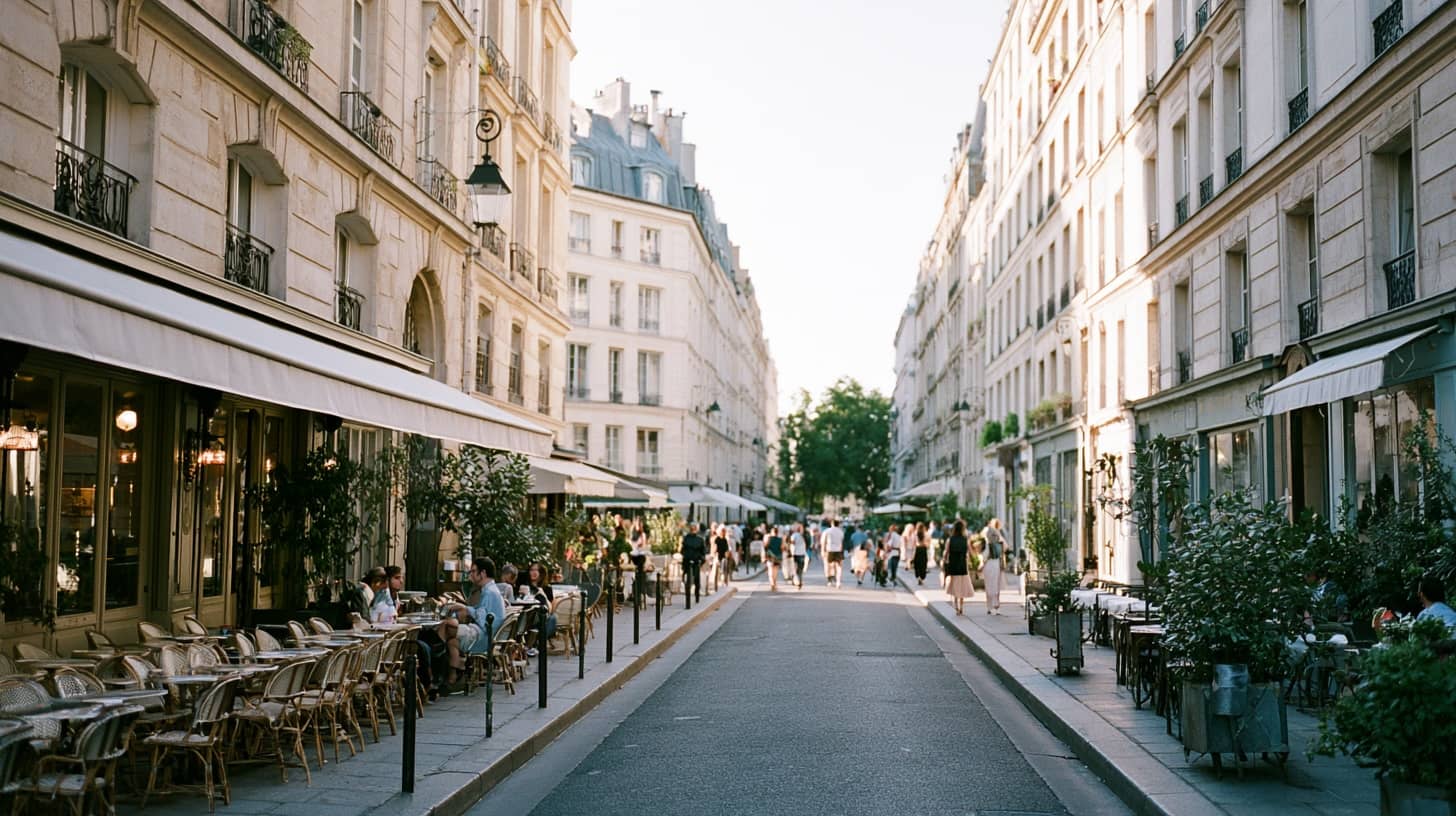
The easiest way to spoil an art day in Paris is to overpack it in the centre. The 11th arrondissement offers a better pace: fewer grand gestures, more galleries you can actually absorb without queue fatigue, and enough cafés nearby to let a painting or two settle in your head.
I like this side of Paris because it keeps the scale human. You can move from a contemporary space to a bookshop, then to a terrace table, without feeling as though you are performing culture for the city.
Why the 11th works for a slower gallery day
The 11th is not a museum district in the heavy, institutional sense. It is more mixed, more lived-in, and therefore easier to use well. Gallery rooms appear between bakeries, bars, furniture showrooms, and ordinary apartment blocks, which is exactly why the walk feels calm rather than ceremonious.
This is also a neighbourhood that rewards looking up and around, not just straight into white walls. The streets around Rue Saint-Maur, Rue Chapon’s wider orbit, and the nearby canal edge give you enough architectural texture without demanding a full sightseeing schedule.
If your Paris time is short, the 11th is useful because it compresses several pleasures into a small area: contemporary art, design retail, good coffee, and enough lunch options to keep you from making a regrettable salad choice out of desperation.
Start near Filles du Calvaire and let the streets do the sorting
I would begin around Filles du Calvaire or Oberkampf, where the pace is lively but not frantic. From here, you can head in several directions without committing to one grand route, which feels especially sensible when gallery-hopping in a city that can tempt you into overplanning.

One good early stop is Thaddaeus Ropac Paris Marais, a polished contemporary space on the edge of Rue Debelleyme. It tends to show work that benefits from scale, so it is worth entering with enough mental room to stand back and look properly.
Nearby, Musée Picasso is just far enough away to count as a detour rather than the main event, and that is part of its appeal. If the day is running generously, it anchors the neighbourhood nicely; if not, save it for another Paris morning and keep moving.
The point here is not to tick off institutions. It is to use the area as a walkable spread of visual stops, the way Paris is often best enjoyed: in measured portions, not in buffet mode.
Choose galleries the way Parisians choose bread: by instinct and repetition
Independent galleries in the 11th often feel more approachable than their polished central counterparts. Many are small enough that one strong exhibition can define the whole visit, which is a blessing if you prefer quality over quantity.
Look for spaces like Galerie Kreo when you want design-forward work, or venues around Rue de Montmorency and Rue Amelot where contemporary artists and collectors orbit the same few blocks. In practice, the best route is usually not linear at all. It is a zigzag, with your eye catching one doorway, then the next.
I also like the district for the way it handles the commercial side of art. It is present, but not pushy. You can look without being cornered into a conversation that starts with “Are you familiar with…” and ends with a monologue about editions.
A few names worth noting
If you prefer to keep your day grounded in a handful of reliable stops, I would keep these on the radar: Galerie Nathalie Obadia, Galerie Julienne, and Galerie Kamel Mennour, depending on what is showing. Each has a different tone, but all fit the neighbourhood’s habit of treating art as part of daily life rather than a special occasion.
Do check the official websites before you go, because Paris galleries can be infuriatingly elusive about maintaining predictable hours. That said, the 11th is a good area for spontaneous pivots: if one door is closed, another interesting one is likely nearby.
Build in a café stop before your attention frays
A gallery route only works if you accept that concentration is finite. In this neighbourhood, I would happily break at Café Orthyodox if you want something polished and calm, or at one of the area’s smaller specialty coffee spots around Rue Saint-Maur if you need a quicker reset.
The cafés here are rarely the sort that overperform for tourists, which is part of their appeal. A good table, a decent espresso, and fifteen minutes of street watching are usually enough to make the next exhibition feel fresh again.
If you want something a little more substantial, this is also an easy district for lunch without losing the plot. Look for a simple bistro menu, a tartine place, or a small wine bar doing a respectable plate of cheese and vegetables. No one needs a three-course performance in the middle of a gallery walk.
For a more design-minded break, the cafés around Rue de Charonne and Rue Saint-Ambroise tend to attract a mixed crowd of remote workers, neighbourhood regulars, and people pretending not to be on their phones. That is about as Parisian as it gets on an average weekday.
Do not ignore the architecture between the art stops
The 11th is full of buildings that are easy to miss if you only follow your map. Haussmannian façades appear in regular stretches, but they are interrupted by former workshop buildings, plain civic structures, and streets that still feel faintly industrial in the best sense.
This matters because the neighbourhood’s visual identity is not concentrated inside galleries. It lives in the proportions of the streets, the worn stone around doorways, and the occasional courtyard that hints at a factory past. If you like architecture, the area gives you enough material to keep your eyes busy between exhibitions.
Rue de Charonne is especially useful for this kind of wandering. It moves between polished retail and older textures without ever becoming precious, and that balance is exactly why it works for a slow art day rather than a formal itinerary.
If you enjoy design objects as much as paintings, the 11th also does well with showrooms and interiors shops. These are the kind of places where a chair becomes an argument and a lamp becomes a small moral position. Paris can be a little like that.
Use Bastille and the canal as your soft boundaries
The neighbourhood’s eastern edge is easy to extend into Bastille, while the northern pull towards Canal Saint-Martin gives the route a different mood. I would not do both in one rushed sweep, but they are useful as optional boundaries if you want to lengthen the walk.
Bastille adds more energy and a slightly harder edge, especially near the Marché d’Aligre area and the streets running back toward Ledru-Rollin. Canal Saint-Martin, by contrast, softens the day with water, bridges, and people sitting too long on the quay, which is one of the city’s more dependable habits.
If you are still hungry for art after the galleries, a detour toward Atelier des Lumières can make sense, provided you are in the mood for a more immersive, more popular experience. I would not make it the core of a refined gallery day, but it works well as a final flourish if your energy holds.
For most travellers, though, the better choice is simply to stop when the route begins to feel crowded. Paris has enough ambitious plans already; your afternoon does not need to match them.
Where to pause without breaking the mood
The best stops in the 11th are the ones that feel useful rather than decorative. A good wine bar, a straightforward bakery, or a small café with proper chairs can matter more than a place that wants to be photographed from every angle.
If you need a bottle-shop-style break or a glass of something decent before dinner, the area around Rue de la Roquette offers plenty of options without much fuss. I am always happier in a neighbourhood where one can have a calm glass of white wine and still return to art without feeling as though one has abandoned the programme.

Bookshops also fit naturally into this route. The 11th is one of those places where you can easily drift from visual art into printed matter, which feels right for a district that understands culture as something handled daily, not only solemnly.
Try to keep one hour at the end of the route unassigned. That hour is for the spontaneous gallery you did not expect, the café you noticed twice, or the decision to sit down and let the day be enough already.
A practical route that does not overcomplicate things
If I were shaping this into a half-day, I would keep it very simple. Begin near Filles du Calvaire, work west and south through a couple of galleries, pause for coffee, then choose either Bastille or the canal depending on how much walking you still want.
For a fuller day, add a museum stop such as Musée Picasso, or build in a late lunch on Rue de Charonne. The 11th is one of those Paris districts where a route improves if you leave slack in it; the neighbourhood is better at suggestion than at rigid scheduling.
- Check gallery websites before leaving your hotel; some smaller spaces are less predictable than their polished façades suggest.
- Wear shoes you can stand in for long stretches. Art days are usually less about mileage than about waiting and looking.
- Carry a small notebook or use your phone notes. A title, a colour, a detail in a work can disappear after the third stop.
- Plan one café break and one possible lunch stop, then treat everything else as optional.
That combination is enough. A good art day in the 11th should feel lightly edited, not aggressively efficient.
When to go, and how to keep it pleasant
In cooler months, this route is especially satisfying because the walking keeps you alert and the cafés feel earned. In warmer weather, start earlier, because the neighbourhood’s charm is not improved by heat fatigue and a slightly sticky back.
Weekdays are generally easier for gallery visits, both because the streets are calmer and because you are less likely to compete with weekend curiosity traffic. If your timing is flexible, aim for a late morning start and let the day stretch into lunch rather than trying to force a grand afternoon.
If rain appears, the 11th still works beautifully. Galleries, bookshops, cafés, and a few good interiors-minded shops can absorb a wet day with far less drama than a monument-heavy itinerary. That is one of the reasons I keep coming back to neighbourhoods like this: they are practical without advertising it, much like Paris after dark.
For official museum information, opening details, and current exhibitions, the safest habit is to check the venue’s own website before you go. Paris rewards curiosity, but not careless timing.
A gallery day that leaves room for the rest of Paris
What I like most about this route is its restraint. It does not try to define the whole city; it simply gives you a way into one of the more interesting, more manageable corners of it.

The 11th works because it lets art sit beside the ordinary business of life. You can step out of a gallery and immediately find a bakery, a metro, a terrace, or a street that looks slightly better in late afternoon light than it has any right to.
That combination makes for a very good Paris day: not too polished, not too exhausting, and just organised enough to leave space for one more stop if something catches your eye. In this part of the city, that usually happens more than once. And if it does, I would not resist too hard. The 11th is at its best when you allow it to steer, very gently, for a few blocks at a time.