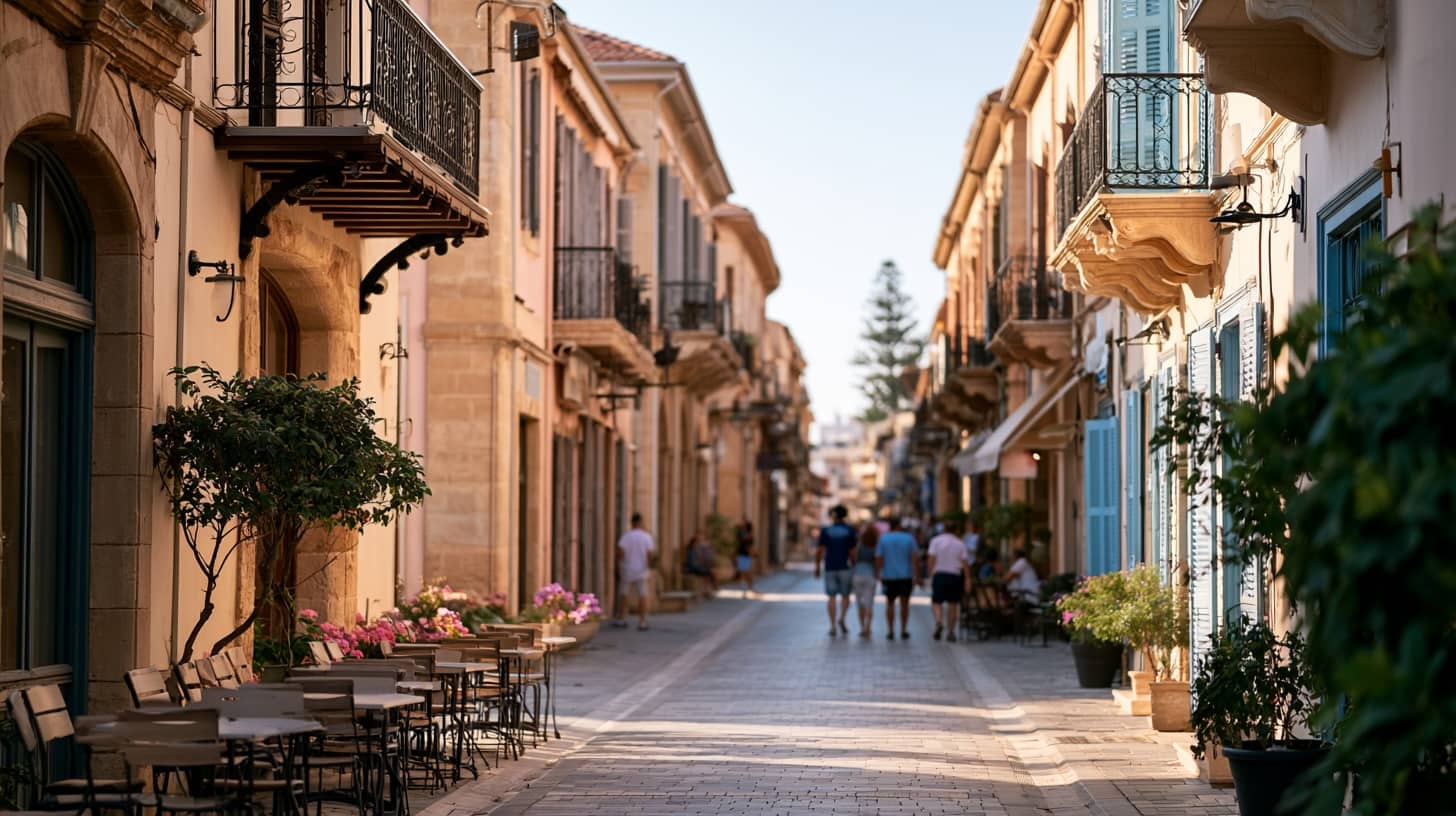
The first thing you notice in Nicosia is not a landmark. It is the shape of the place: a city that keeps arranging itself around borders, courtyards, arcades, and abrupt turns. On a map, it looks compact. On foot, it feels layered, with old walls, modern traffic, and café tables all insisting on different tempos.
That makes Nicosia a little tricky for the usual quick city-break mindset. It is not a place to skim and tick off. It asks you to notice the crossings, the textures, the silences between busy roads, and the way the old town can change mood after only a few streets.
The city announces itself by contrast
If you arrive expecting a single centre, you will spend the first hour recalibrating. Nicosia is split between the historic walled city and newer districts outside it, with the Green Line slicing through the middle like a reminder that geography here is political, not decorative. That division is part of the city’s everyday rhythm, not an abstract lesson.
The result is a place where a Renaissance bastion, a government building, a student café, and a shop selling electrical goods can all feel oddly adjacent. For a visitor, that means the city rarely performs a neat postcard version of itself. It prefers friction, and then quietly rewards anyone willing to walk through it.
The old town, especially around the official tourism pages for Nicosia, is where the contrasts sharpen. You move from shaded lanes to broad sunlit streets, from restored façades to buildings that still look half-occupied by time. It is not polished in a monotone way, which is precisely why it stays interesting.
Start inside the walls, not beside them
The old city makes the strongest first impression when you enter it on foot and let the walls do their work. The Venetian fortifications shape the city in a way you can feel almost immediately. They do not just mark history; they determine how the streets bend, where the light pools, and how much the city reveals at once.
Ledra Street is the obvious artery, but the smarter move is to treat it as a threshold rather than a destination. Step off it early and look for the smaller lanes where the city is less polished and more itself. That is where you start noticing carved balconies, low stone façades, and the occasional office building that looks like it was dropped in from another decade and never explained.
The old quarter also rewards slow pivots. Walk a block, turn again, and suddenly the mood changes from retail to residential, from café chatter to near silence. In many European centres, that sort of shift is tidy and curated. Here it feels more improvised, and therefore more alive.
The Green Line changes how you read the street
One of the most striking things about Nicosia is that its split is not hidden from you. You may encounter checkpoints, pedestrian crossings, and streets that stop feeling ordinary because they run close to the divide. This is not a dramatic spectacle. It is more unsettling than that: everyday, practical, and impossible to ignore.
For visitors, the most useful response is simply to stay attentive and keep moving respectfully. If you plan to cross between the south and north, check current rules and documentation requirements before you go. Conditions can change, and the city deserves better than guesswork. Official guidance from local authorities is worth consulting before you set out.
That political geography also shapes the atmosphere. Some streets feel purposefully busy, as if life is determined to continue without comment. Others feel suspended. The city teaches you, quickly, that what looks like a simple walk may also be a lesson in absence, memory, and persistence.
What to actually see first
For a short trip, I would prioritise a compact set of places that show different sides of the city without exhausting you. Start with the Leventis Municipal Museum, which gives a clear, intelligent overview of Nicosia’s civic story and helps you orient yourself before the more fragmented pleasures of the streets. Then go to the Cyprus Museum for the deep-time version of the island, where archaeology makes the present feel less solitary.
If you want architecture and public life in one go, the area around Eleftheria Square is worth your attention. Zaha Hadid’s design gives the city a sharply contemporary edge, but it is most interesting as a place where pedestrians, traffic, and open space negotiate with one another, especially if you’ve read about why staying outside Old Town can change how you experience Nicosia. It is a good reminder that Nicosia is not frozen in heritage mode.

For a slower, more tactile stop, the Hadjigeorgakis Kornesios Mansion offers an elegant view into Ottoman-era domestic architecture. It also helps balance the city’s harder edges with a sense of lived-in domestic history. That contrast matters here. Nicosia works best when you let the museums and streets speak to each other.
The café scene is a map of the city’s current mood
What makes Nicosia feel contemporary is not a flashy skyline or a flood of chain places. It is the café culture, which functions as social infrastructure. People linger properly here. They read, talk, work, and sit through the heat with an admirable refusal to rush.
In the old town, the cafés tend to be strongest when they are slightly irregular: a courtyard space, a narrow frontage, a place that feels more assembled than branded. In newer parts of the city, you will find more polished espresso bars and design-led interiors. Both have their uses, but the old quarter has more personality per square metre.
If you need one practical rule, it is this: take your coffee sitting down. Nicosia is a city to pause in, not to consume efficiently. Even a brief stop in the right place gives you a better read on the city than an hour of brisk sightseeing.
The neighbourhoods that give the city shape
Within the walled city, Laiki Geitonia is one of the easiest areas to understand at a glance: restored lanes, craft shops, places to eat, and enough pedestrian friendliness to let you settle in. It can feel touristed, yes, but that also makes it useful as a base for first orientation.

For a more everyday feel, push toward the lanes around Trypiotis and the broader commercial centre. Here, the city becomes less decorative and more functional. Offices, small shops, old houses, and renovation projects sit beside one another in a way that tells you plenty about how Nicosia actually lives.
If you have more time, the area around Omeriye and the nearby mosque, baths, and mixed historical layers gives a sense of how the city’s religious and architectural inheritance overlaps. Nothing about these districts is neatly packaged. That is part of the appeal.
Food is where the city becomes more generous
Nicosia’s food culture is not trying to impress you with novelty. It is more interesting than that. You get Cypriot cooking anchored in local produce, mezze that rewards company, and a strong sense that lunch is an occasion, not an inconvenience. This is a city where a table can become a plan.
For a first visit, I would lean toward dishes that show the island rather than generic Mediterranean fare. Halloumi, of course, but also souvla, sheftalia, seasonal vegetables, and anything that arrives with the quiet confidence of a kitchen that does this every day. Markets and traditional tavernas remain the best places to find that kind of straightforward pleasure.
If you want a more polished evening, the city’s contemporary restaurants and wine bars can be very good, especially in the centre and in neighbourhoods just beyond it. But I would still recommend beginning with the simpler places. Nicosia does not need costume dining to feel distinct.
How to spend a short trip without wasting time
Three things improve a short stay immediately. First, stay central if you can, ideally near the old city or within an easy walk of it. Nicosia is not hard to navigate, but distance matters more here than it does in more compact European capitals, especially in the heat.
Second, plan around the light. Morning is best for walking the walls, photographing façades, and seeing the old town before it softens under the afternoon sun. Late afternoon is better for cafés, museum stops, and a more social atmosphere as the city starts to relax into the evening.
Third, leave room for a border crossing if it interests you, but do not make it your only reason for being here. The city is bigger than its division. The better experience comes from seeing how that division shapes daily life rather than treating it as the whole story.
- Wear comfortable shoes: the best parts of the centre are meant for walking.
- Carry water and plan indoor breaks; summer heat can flatten enthusiasm quickly.
- Check official guidance before crossing between north and south.
- Use the museums early in the day, then save cafés and neighbourhood wandering for later.
- Keep cash handy for smaller places, especially in older parts of the city.
Where the city feels most itself after dark
Nicosia’s evenings are less about spectacle than adjustment. After the daytime heat, the streets loosen up, tables spill outward, and the city becomes more conversational. You start seeing who is out for dinner, who is there for a drink, and who is simply extending the day because there is no reason not to.
The atmosphere is strongest in the centre, where bars, restaurants, and cafés are close enough that an evening can shift gears without much planning. It is not a party city in the obvious sense, which is a relief. The social life here is more adult, more local, and less interested in performing for visitors.
If you want a cleaner sense of what contemporary Nicosia sounds like, sit somewhere with a terrace and listen. You will hear Greek, Turkish, English, and the easy code-switching of a city that has learned to live with several registers at once. That, more than any single monument, is the city’s first impression.
Why Nicosia stays with you
The city’s most lasting quality is not charm in the conventional sense. It is intelligence. Nicosia asks you to pay attention to structures that are not always visible at first glance: political boundaries, old commercial routes, domestic architecture, and the quiet continuity of everyday life.
That makes it especially good for travellers who like a city to reveal itself gradually. If you prefer polished certainty, you may find it more challenging than expected. If you enjoy cities with a little resistance, though, Nicosia offers a proper reward: depth without performance.
The first thing you notice may be the split, the walls, or the heat radiating off the pavement. The thing you remember is that all of it adds up to a city that refuses simplification. For a short trip, that is a very good reason to go.