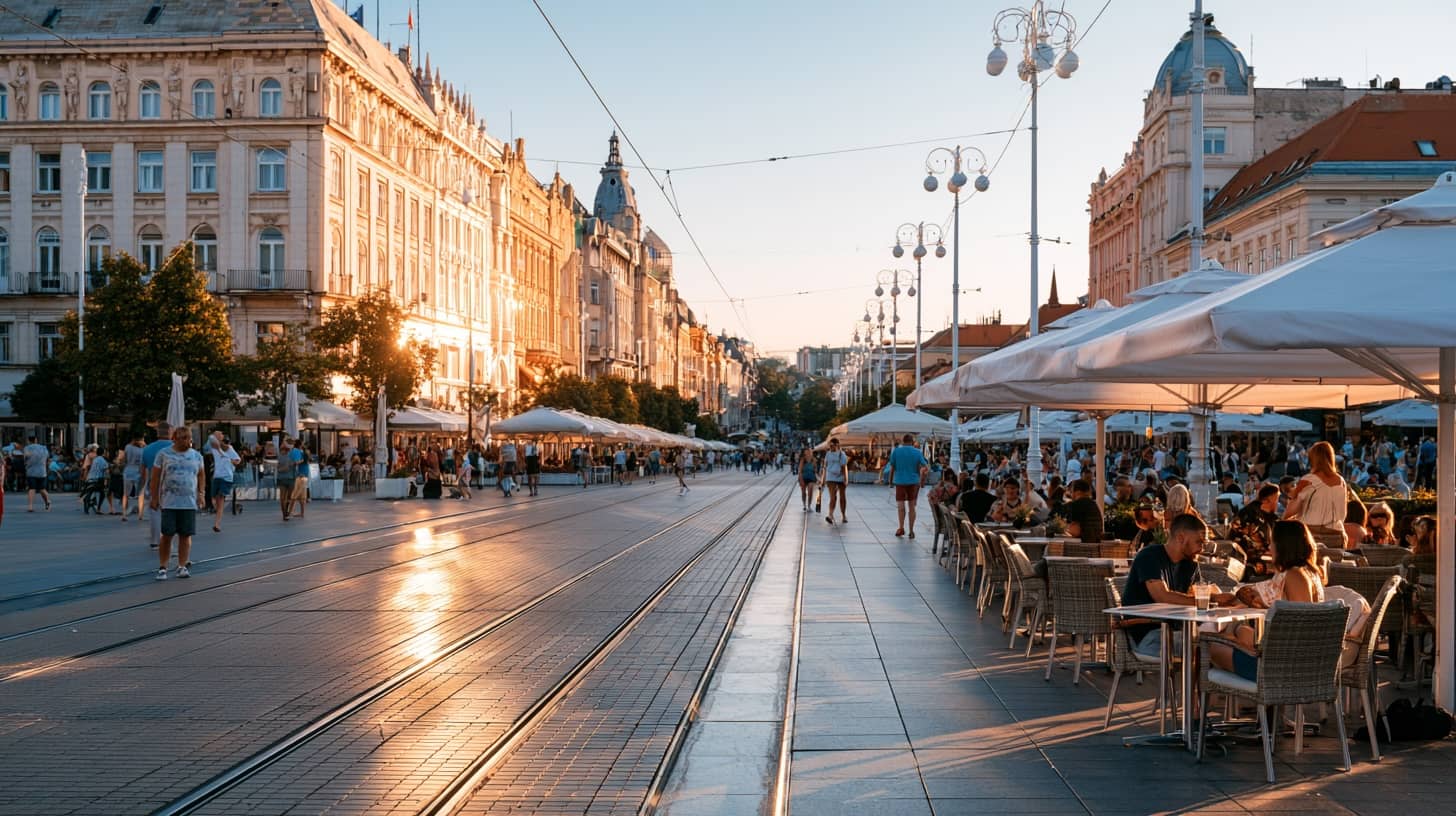
The first mistake is treating Ban Jelačić Square like a finish line. It is useful, yes: a tram hub, a meeting point, a place where people move in every direction with efficient Zagreb impatience. But if you stop there, you get the city as a crossroads instead of a place with layers.
I prefer Zagreb approached sideways. Follow a tram line. Drift uphill. Sit down twice before lunch. The city reveals itself in fragments: the upper-town lanes, the museum-heavy eastern edge, the café streets where lunch can stretch into the afternoon, and the neighborhoods that feel like someone actually lives here, which is usually a good sign.
Start with the square, then leave it
Ban Jelačić Square is not unimportant. It is where the city’s rhythms announce themselves, from commuters to schoolchildren to older regulars who know exactly where they are going. But the square is a transfer point, not a destination. Even the best cities are honest about this distinction.
From here, I would not linger long unless you need a coffee or are orienting yourself. The real pleasure is in the short exits: up toward the historic core, east toward the museum quarter, or south into streets that look ordinary until you realize they carry much of Zagreb’s daily life. If you want a city that makes sense on foot, this is where it starts to make that promise.
For a useful first read on the city after dark, or simply after a long museum day, an evening in Zagreb helps frame how the center works once the daytime rush softens. The point is not to stay central forever. The point is to know when to stop treating the square as the whole map.
Walk uphill, because the old city still matters
Zagreb’s upper town is the clearest argument against square-centrism. The climb is short, but the mood changes quickly. Stone lanes, civic buildings, church towers, and the kind of quiet that suggests people are thinking about errands rather than grand statements. That is usually more interesting anyway.
St. Mark’s Church gives the area its famous roof, but I would not make the mistake of reducing this part of town to one photograph. The Lotrščak Tower, the Stone Gate, and the small passages between them are better experienced as a compact walk than as a checklist. You do not need to “do” the upper town; you need to let it reorient you.

The appeal of the area is its scale. You can move from a government district to a side lane in under a minute, then suddenly find a café terrace where the pace drops enough to notice the façades. For architecture-minded travelers, this is the clearest place to understand how Zagreb layers Austro-Hungarian formality over a more intimate street plan.
Use the tram as a planning tool
One reason Zagreb works so well for slow travel is that the tram network behaves like a practical diagram of the city. It is efficient without being anonymous. If you know the lines and the stops, you can move across neighborhoods without wasting energy on taxi debates or overly optimistic walking routes.
The Zagreb Electric Tramways site is worth a look if you want to understand the basics before you go. You do not need to turn transport into a hobby, but a little preparation pays off here. It makes the city feel less like a central square with extras and more like a connected set of lived-in districts.
For visitors, the practical win is simple: use trams to link the center with places you would otherwise postpone. The museum zone is one example. The café streets around Martićeva are another. Even if you prefer walking, tram knowledge gives you freedom when the weather changes or your legs decide they have opinions.
Head east for museums and a more serious pace
If the square is where people meet, the museum zone is where Zagreb gets a little more formal. This side of town is a useful correction to any idea that the city is only about cafés and old-town charm. There is substance here, and quite a lot of it.
The Mimara Museum, the Croatian Museum of Naïve Art, and the Croatian Natural History Museum give the city enough range for a proper cultural day. I would not try to cram them all in. Choose one or two, then give yourself time for the spaces between them, because Zagreb is very good at the in-between part.
If your visit falls on a wet or gray day, this is where the city becomes especially sensible. A museum-heavy plan can absorb weather, jet lag, and the temptation to retreat to your hotel too early. For a more structured take on that kind of day, a rainy day in Zagreb can be a useful companion before you head out.
Maksimir and the east side are the city’s lungful of air
Not every Zagreb day should be built around stone streets and café tables. When the city feels too compact, head toward Maksimir. The park changes the pace immediately, and that matters more than the usual “green escape” language suggests. It is less a dramatic break than a practical reset.
Maksimir Park is best when you want a long walk that does not feel like exercise in disguise. It has room, trees, water, and enough local life around it to keep it from feeling sealed off from the city. Nearby, Zagreb Zoo and the surrounding residential streets remind you that this is not an ornamental park for visitors alone.
This eastern stretch also helps correct the tourist habit of staying too near the postcard center. Zagreb is more convincing when you see how families, runners, and dog walkers use the city on an ordinary weekday. That everyday activity gives the place its steadiness.
Cafés are not a side note here
In many cities, café culture is talked about like a personality trait. In Zagreb, it is closer to infrastructure. You need cafés the way you need trams: as places to sit, recalibrate, watch people, and decide whether you are in the mood for another uphill walk or a second coffee. The city respects this decision-making process.
In the center, I would look for terrace-heavy spots around Tkalčićeva, but I would not confine myself there. Martićeva has a more lived-in feel, with independent places that are better for lingering than for performing a quick espresso stop. Elsewhere, hotel cafés can be genuinely useful too, especially if you want a quieter, room-temperature pause between walking routes.
If you use coffee stops to understand a neighborhood, Zagreb rewards that habit. Watch who is there, how long they stay, and whether the seating is arranged for conversation or for people who want to be left alone with a newspaper and a pastry. Both are valid city moods.
Dolac is the city’s practical morning anchor
Dolac Market sits close enough to the center to be easy, but it never feels like a tourist prop, which is exactly why I would include it in any first serious Zagreb day. The red umbrellas are the obvious image, but the better value is in the movement: vendors setting up, regulars buying produce, the small matter-of-factness of people shopping because they need dinner.

Come in the morning if you can. That is when the market feels most useful and least performative. The upper levels, the produce stalls, and the surrounding streets create a good transition between the square, the old town, and the café stops you will almost certainly want afterward.
From a travel-planning point of view, Dolac works well as a breakfast-adjacent stop rather than a separate expedition. Buy something, snack as you walk, and keep moving. Zagreb is at its best when the city and the errand are allowed to share the same hour.
Choose neighborhoods by tempo, not by fame
The mistake I see most often is trying to make Zagreb behave like a simple center-plus-suburbs map. It is more useful to think in tempos. The lower center is practical and dense. The upper town is compact and historic. The museum quarter is deliberate. Martićeva and nearby streets are calmer, with a more local rhythm.
If you are deciding where to spend limited time, ask what kind of day you want. For architecture and monuments, stay near the old core. For meals and café-hopping, drift toward the streets east and north of the square. For a slower residential feel, follow tram lines outward rather than assuming you need to leave the city entirely to find breathing room.
Travelers who like walkable cities often relax here because Zagreb does not punish a change of plan. You can turn a museum morning into a park afternoon and a café evening without feeling like you have broken the logic of the day. That flexibility is one of its strongest qualities.
Where to stay if you want the city to work for you
Location matters in Zagreb, but not in the flashy way it does in cities with one obvious center and a strong tourist funnel. I would prioritize places that let you reach the square, the tram lines, and one or two neighborhood streets without effort. That combination is more useful than a view you will only admire for thirty seconds.
If your hotel is near the lower center, you can do a lot on foot and still have easy tram access. If you are slightly north or east of the square, you may trade instant monument access for better cafés and a calmer sleep at night. That trade is worth considering, especially for travelers who prefer the city to feel daily rather than ceremonial.
For readers weighing whether one night is enough, the answer is usually no. A second night helps you move beyond the square and into the city’s actual texture. It is also the difference between seeing Zagreb and understanding how to spend time here without overplanning it.
A sensible one-day route for first-timers
Here is the version I would suggest if time is short and you want the city to feel coherent rather than rushed. Start at Ban Jelačić Square, then move uphill through the upper town. Continue to a museum or two in the center, break for lunch somewhere that allows lingering, and finish with a late-afternoon café stop away from the busiest tram crossings.
If you still have energy, walk toward the eastern streets or take a tram to Maksimir. The point is not to “see everything.” The point is to let the city change shape at least once during the day. That is usually enough to make the center stop pretending to be the whole story.
- Begin early at Dolac for the most useful market atmosphere.
- Use one tram ride to save energy for walking uphill.
- Pick one major museum instead of three rushed ones.
- Take your longest coffee break in a neighborhood street, not on the square.
- Leave room for an unplanned second stop; Zagreb improves when the day is not over-scripted.
What I like most about Zagreb is that it resists being reduced to a single postcard center. Ban Jelačić Square matters, but it is only the opening chord. The city comes into focus when you move away from it with intention: uphill, eastward, along the tram lines, and into the places where daily life does not need to announce itself.
That is the real starting point. Not the square. The sequence after it.