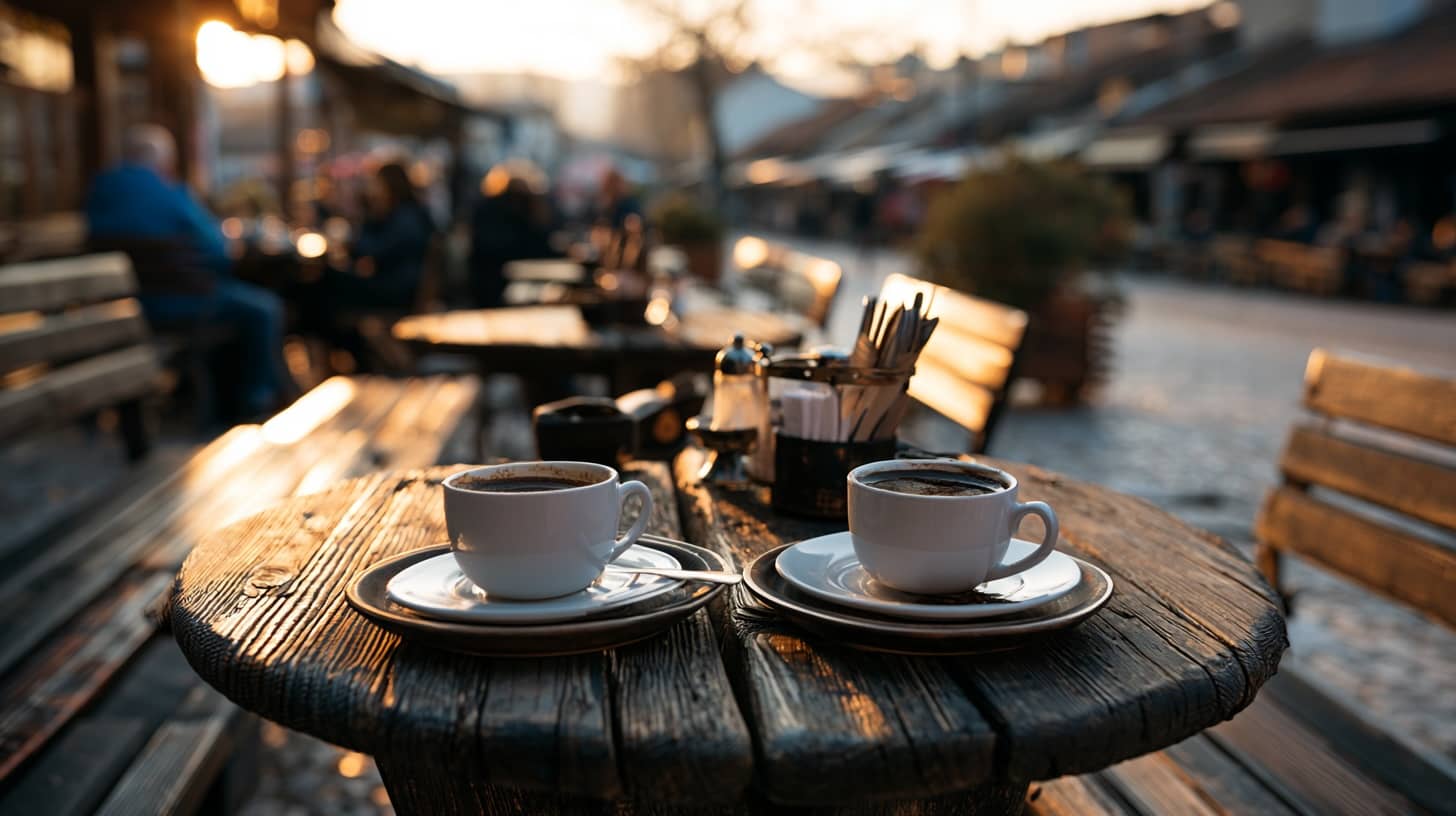
The quickest way to spoil a Sarajevo morning is to treat coffee like a pit stop. Here, coffee is the plan, the pause, and often the excuse to sit for another half hour while the city gets on with its day.
I like that about Sarajevo: it makes room for a lingering breakfast. If you want the mood to match the setting, build your morning around one cup in Baščaršija, another in the wider centre, and a final stop somewhere with a terrace, a pastry, and a view of ordinary life doing its thing.
Start with the city’s oldest rhythm
Begin in Baščaršija, where coffee still feels ceremonial rather than efficient. In the old bazaar, the stainless-steel coffee pot and small cups are not a performance for visitors; they are part of the daily grammar of the place.
Settle at a traditional café and order Bosnian coffee in the classic style, with a small glass of water and, if you want it, a cube of lokum. The point is not to rush the sugar or the caffeine. The point is to let the neighbourhood wake up around you while you watch shop shutters rise and metalworkers, bakers, and early walkers thread through the lanes.
If you want a nearby reference point before you wander, the where to stay in Sarajevo guide is useful for figuring out whether you want to sleep close to the old centre or a little farther west, where the café circuit gets more modern and less crowded with first-timers.
Know the difference between a coffee stop and a coffee atmosphere
Sarajevo has both, and you want the latter. Some places are built for a quick espresso and a receipt; others are places where time seems to loosen its belt a notch.
In the old town, the mood is usually traditional and social, with low tables, patterned rugs, copper details, and a steady stream of people who have clearly been meeting here for years. A few streets away, you start finding contemporary cafés that could belong in any stylish European city, but with a Sarajevo accent: more light, better windows, and a stronger sense that the barista is paying attention. That same easy pace carries beyond the center, too, as you wander Sarajevo at a slower rhythm.
That mix is what makes a slow-morning circuit work. I wouldn’t try to do every stop in the same style. Let one café be about history, one about neighbourhood watching, and one about good espresso that happens to come with better chairs.
Make your first stop a classic, not a checklist
If you only want one traditional coffee experience, choose it early, before the bazaar fills up with everyone who had the same idea. The pleasure is partly in the soundscape: teaspoons, chairs scraping, vendors opening up, and the occasional call to prayer folding into the morning rather than interrupting it.

Places like Café de Alma and the old-town coffee rooms around Brusa Bezistan are useful reference points for this kind of morning, as are the cafés tucked among the lanes near Gazi Husrev-beg Mosque. I’m not after novelty here; I want a good tray, a calm corner, and coffee served with the kind of competence that suggests nobody is trying to reinvent the wheel.
The trick is to sit long enough to notice how locals order. Some take theirs with sweets, some with cigarettes, some with no visible urgency at all. If you’re watching the city and wondering why no one is hurrying, you’re doing it right.
Walk uphill, then reward yourself with a second cup
After the first coffee, I like a short walk to clear the sugar and earn the next stop. Sarajevo is generous with gradients, so even a modest uphill stroll changes the pace of the morning.
Head toward the historic edges above the bazaar or drift along the tramline toward the centre, depending on your mood. The point is not exercise for its own sake; it’s to let the city shift from intimate alleyways to wider streets, where Austro-Hungarian façades and modern traffic share the same frame. That contrast is one of Sarajevo’s strongest arguments for slow travel.
By the time you’re ready for cup number two, you’ve usually moved into a different register. The coffee can be more contemporary now: stronger espresso, a cleaner interior, a brighter room, maybe a pastry that is technically breakfast and emotionally brunch.
Where I’d look for the best mid-morning espresso
For the second stop, I want somewhere that takes coffee seriously without turning it into theatre. Sarajevo has plenty of places that fit the brief, especially as you move away from the old bazaar and into streets where office workers, students, and designers overlap.
In and around Ferhadija and the centre, cafés often lean Italian in style: quick service, compact menus, and espresso that comes with fewer speeches and better extraction. That’s not a criticism of the traditional places. It’s just a different mood, and on a long morning I think you need both.

If you like a more polished room, look for cafés with strong light, good baked goods, and a crowd that looks like it knows exactly how long it will stay. The best ones make you feel faintly underdressed in a flattering way.
Don’t skip the pastries
There is no serious café morning in Sarajevo without pastry damage. You can pretend otherwise, but the city will win.
Go for something flaky, sweet, or filled, and treat it as part of the itinerary rather than an optional extra. A good morning might include baklava, krempita, or one of the many bakery-counter pastries that vanish faster than they appear. If you want a proper sit-down break, pair coffee with burek or sirnica from a bakery that has regulars coming in at all hours; the exact form matters less than the freshness.
What I like most is the practical generosity of it. Sarajevo cafés rarely behave as if coffee has to arrive alone. The city understands that a second cup goes down more gracefully with something buttery or sweet in the corner of the saucer.
Move west for a more everyday Sarajevo
Once you’ve had your old-town moment, keep walking west toward Marijin Dvor. This is where the café circuit becomes more everyday and less postcard-ready, which is exactly why I like it.
The streets widen, the pace changes, and the cafés start serving a different crowd: people in transit, people on laptops, people on a proper morning break. It’s also the point where Sarajevo’s layers feel very visible. Ottoman-era traditions are no longer the only reference; you get offices, shopping centres, tram stops, and cafés that could be in Vienna one minute and unmistakably Sarajevo the next.
If you’re choosing a base in the city, this is the moment where neighbourhood sense really matters. Old-town proximity gives you atmosphere; Marijin Dvor gives you convenience and a less tourist-heavy coffee routine. Both are useful, depending on how much you want to sleep and how much you want to walk.
Use the tram as part of the circuit
Sarajevo’s tram is not just transport; it is a moving line through the city’s social geography. For a café morning, that matters.
Take it if your feet need a break, or simply to see how the city changes between stops. A tram ride between the old centre, Ferhadija, and Marijin Dvor can save your legs for the better part of the day, especially if you’re planning to keep wandering after coffee. It also gives you a nice window on daily life: schoolkids, shoppers, workers, and people carrying takeaway cups like they’ve got things to do.
If you prefer to keep things fully on foot, fine. But I’d still recommend building one public-transport moment into the morning, because Sarajevo becomes much easier to read once you stop treating each neighbourhood as an isolated attraction.
A good café route for a slow morning
If I were drawing this out for a friend, I’d keep the route simple. Start with a traditional coffee in Baščaršija, walk toward the centre, then finish with a cleaner espresso stop around Ferhadija or Marijin Dvor.
- First stop: Bosnian coffee in the old bazaar, where the ritual matters as much as the drink.
- Second stop: a pastry break somewhere central, ideally after a short walk.
- Third stop: espresso in a brighter, more modern café with room to sit.
- Optional extra: a tram ride or a slow stroll toward the river to stretch the morning out.
That structure works whether you have two hours or four. It also keeps you from making the common mistake of ordering the same experience three times in a row and calling it variety.
Where to linger after coffee
Once you’re properly caffeinated, you have options. Sarajevo is not the kind of city that demands a strict itinerary before noon, which is part of its appeal.
You could drift back through Baščaršija and browse brass shops, bookstalls, and little food counters without any pressure to buy. You could head toward the river for a gentler walk, or continue into the central streets around Titova and Ferhadija, where the architecture gets more formal and the city feels more legible in layers. If the weather is kind, the simple act of sitting outside with a second pastry and watching the city come into itself is reason enough to pause.
For a slower, more culture-heavy day, the cafés also pair well with a museum stop. The National Museum of Bosnia and Herzegovina is the obvious heavyweight if you want a serious dose of context later in the morning. If you prefer your coffee circuit to lead into architecture and history rather than shopping, that pairing makes sense.
Practical tips for drinking Sarajevo well
A few things make the morning easier. First, carry some cash; not every café behaves like it lives inside a contactless utopia. Second, don’t assume the best coffee is the fastest coffee. Sarajevo tends to reward patience more than efficiency.
Third, take your cue from the room. In a traditional café, lean into the ritual and order Bosnian coffee without overthinking it. In a contemporary espresso bar, keep it simple and trust the barista to know what they’re doing. There’s no prize for overcomplicating a morning that already has a good rhythm.

Fourth, be aware that the city’s best café moments often happen outside the obvious peak times. Early morning gives you calm; late morning gives you people-watching; midday starts to slide toward lunch. I’d aim for the sweet spot in between, when the tables are full enough to feel alive but not so full that you’re negotiating for a chair.
What this circuit tells you about the city
Sarajevo’s café culture works because it refuses to choose between tradition and modernity. One cup can take you back through centuries of Ottoman influence; the next can land you in a sleek room with excellent flat whites and a laptop crowd pretending not to be in a hurry.
That range is what makes a slow morning here feel satisfying rather than indulgent. You get to see how the city actually spends its time, which is usually to say: together, over coffee, with a decent pastry within reach.
If you like your travel days to begin quietly and build slowly, Sarajevo is very good company. Start with one carefully made cup, add a walk, then another cup. By the time the city is properly awake, so are you.