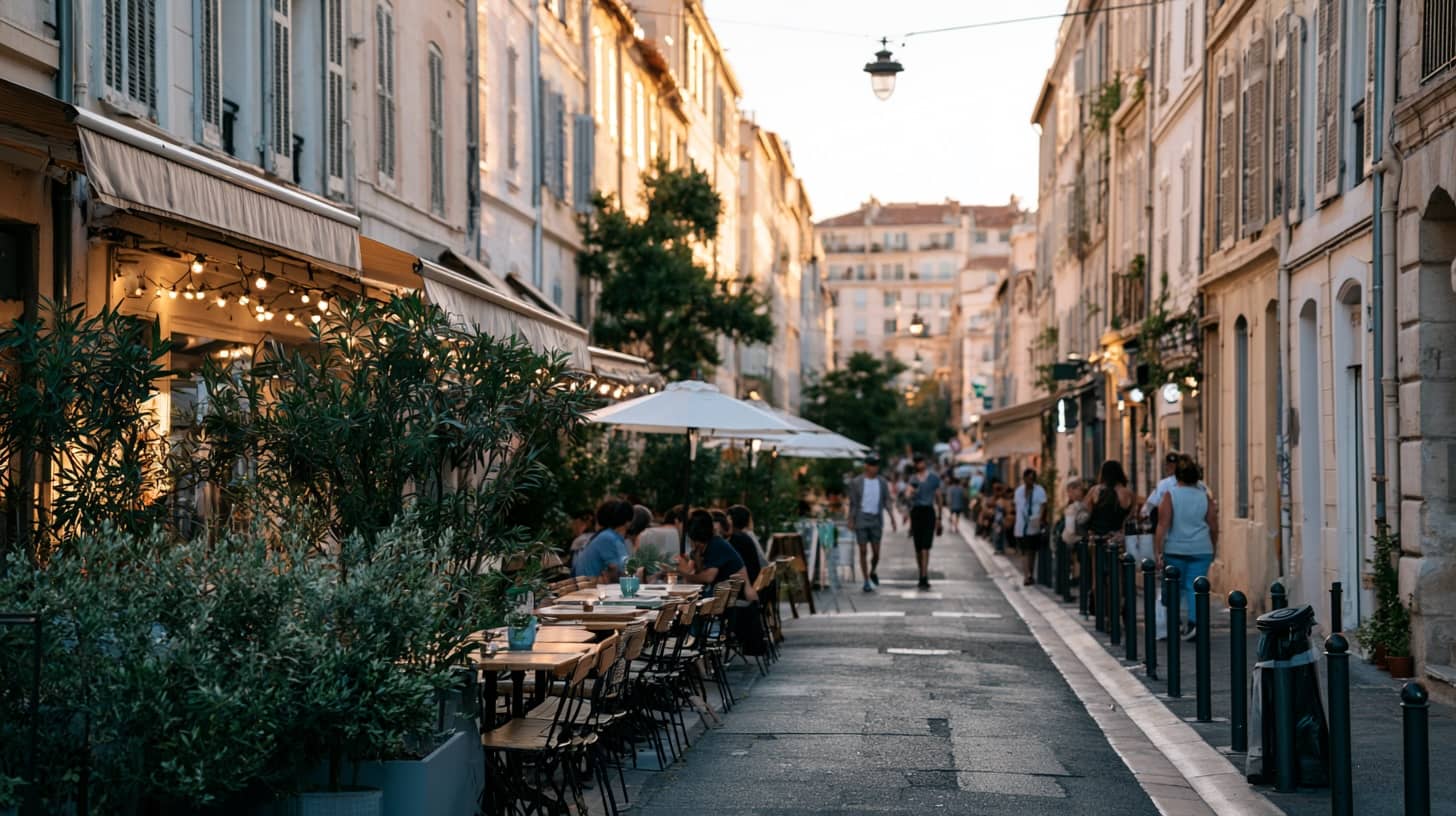
The fastest way to make Marseille feel ordinary is to spend the whole day around the Old Port. It is useful, yes, and dramatic in the way busy waterfronts tend to be, but it is also where many trips flatten into the same loop of boats, lunch, and souvenir fatigue. I would treat it as a waypoint, not the point.
The better version of the city starts a little inland, or uphill, or along a tram line. That is where the pace changes, the streets feel more lived-in, and Marseille’s mix of rough edges and polish makes more sense. You still get the sea, naturally. You just do not need to stand in front of it every ten minutes.
Start with the city’s rhythm, not its postcard
If you arrive expecting a tidy waterfront promenade to organize your day, Marseille will happily resist. It is a city of sequences: metro, tram, hill, market, café, museum, then another hill if you are feeling optimistic. The point is not to collect landmarks. It is to let the city keep changing around you.
That is why I prefer starting in neighborhoods where people are actually living their day. Around Cours Julien, La Plaine, and Noailles, the city feels less packaged. Shops open onto sidewalks, bakeries carry the morning, and you get a clearer sense of Marseille’s scale without the port’s constant performance.
If you want a first orientation, the official tourism board’s city maps are useful, but I would not let them dictate the day. Marseille works better when you move from one practical stop to another: coffee, market, gallery, lunch, viewpoint. It is not complicated, just less obvious than the harbor.
Cours Julien is where the city loosens its collar
Cours Julien is one of the easiest places to understand why skipping the Old Port makes sense. The area is full of independent cafés, record shops, small bars, and walls that seem permanently in conversation with street art. It is not precious. That is part of the appeal.
I like it early, before the day gets performative. Coffee here is less about ceremony and more about giving yourself a base for walking. Sit outside if you can, watch the neighborhood wake up, and notice how quickly the streets fill with delivery scooters, art students, dog walkers, and people who look as if they have plans but not an itinerary.
From here, it is easy to drift toward La Plaine, where the city feels slightly louder and a touch more democratic. The market energy is informal and practical. You can buy fruit, olives, bread, and enough snacks to accidentally create lunch without meaning to.
Noailles is messy in the best possible way
Noailles is not the place for a polished city-stroll fantasy. It is busy, useful, and gloriously unsanitized, with spice shops, North African grocers, produce stalls, and cafés that do not seem interested in making themselves easier for you. I find that refreshing. It also tells you much more about Marseille than a marina ever could.
Come here hungry, but not in a rush. The neighborhood rewards people who are willing to slow down and look at ingredients rather than just menus. A good bakery or snack counter can become a full lunch if you let it, and Marseille is a city where this kind of improvisation feels entirely appropriate.

If the density gets too much, which it sometimes does, you are close enough to peel off toward quieter streets. That contrast is part of the neighborhood’s value: intense one minute, breathable the next. It is one of the few places where a city can feel both intimidating and helpful at the same time.
Skip the port for museum time at MuCEM and the fort
I am not suggesting you avoid the water altogether. I am suggesting you approach it through something better designed than a lunch terrace. MuCEM, Marseille’s museum of European and Mediterranean civilizations, gives you a strong reason to cross toward the harbor without settling into port-side idleness. The building itself is reason enough to go, and the rooftop walk adds a practical view without making you work too hard for it. Check the official MuCEM website before you go.
From MuCEM, the walk to Fort Saint-Jean is one of the city’s easiest high-return moves. The stone passages, ramps, and edges give you a slower, more architectural encounter with the waterfront than the Old Port ever does. You get sea, history, and space to breathe. The combination is hard to improve on.
This is also a good reminder that Marseille is a city of thresholds. It often improves the moment you stop treating the waterfront as a destination and start treating it as a bridge to somewhere else. The fort and museum do that beautifully.
Use the hills for perspective, not just the view
Marseille’s hills are not decorative. They shape how the city works, where people live, and how tiring a day becomes. That matters. If you want to understand why the city feels so layered, make time for one uphill stretch, even if you are not especially in the mood for cardio disguised as culture.
Notre-Dame de la Garde is the classic choice, and for good reason. The basilica delivers the city-wide view everyone wants, but the approach matters as much as the panorama. Walking up gives you a better sense of the urban fabric, the traffic, and the sudden shifts from dense streets to open sky. If your legs object, a bus is the civilized option.
For something less obvious, Parc Valmer and the edges around Endoume give you a more residential kind of elevation. Here the sea appears in fragments between buildings and trees, which can be more satisfying than the full postcard version. It feels closer to how the city actually lives.
Choose neighborhoods that let you stay out of the loop
If you are spending more than a day, where you stay matters. The area around the Old Port is convenient in the narrow sense, but convenient can become repetitive quickly. I would rather be somewhere with a bit of neighborhood texture, even if it means a tram ride back from dinner.
Le Panier has atmosphere, but it can feel like a set after dark. For a stay that is easier to live in, I would look at parts of the 1st, 6th, or 7th arrondissements, depending on whether you want cafés, culture, or a more residential feel. Endoume and Bompard are especially good if you prefer quieter evenings and a more local morning rhythm.
For hotels, I lean toward places that make the city feel navigable rather than theatrical. A well-located boutique stay with a calm room and a decent breakfast will do more for your Marseille trip than a sea view you barely use. If you need help choosing a base, think in terms of tram access, not just waterfront proximity. Marseille rewards movement, not just scenery.
Eat where the city does, not where it poses
Food in Marseille is best when it feels a little unforced. The city has no shortage of seafood, of course, but I would not plan the whole trip around a formal fish lunch on the port. Instead, look for places where the menu reflects the neighborhood rather than the souvenir trade—especially if you are staying in a quieter base that still feels central.
A good Marseille day might include a coffee and tartine in Cours Julien, a market snack in Noailles, and a late lunch somewhere that takes itself lightly. You are in a city where lunch can be simple and excellent without becoming a production. That is a luxury, frankly.
If you want something more structured, the city’s food halls and small bistros offer a useful middle ground. You can eat well without spending half the afternoon in a line or an overdesigned dining room. Marseille’s appeal is that it still allows for casual competence, which more cities should copy.
- Start breakfast in a neighborhood café rather than on the waterfront.
- Use markets for snacks and unplanned lunch pieces.
- Save one proper seafood meal for a day when you are not already tired.
- Choose restaurants a few streets away from the most obvious tourist drag.
Let the city’s architecture do some of the talking
Marseille is not a museum piece, but its architecture is one of its strongest arguments against staying near the port all day. There is the 20th-century confidence of the Unité d’Habitation by Le Corbusier, which still feels oddly modern in the best and most practical way. There are the Haussmann-era façades, the rougher street corners, the modern interventions, and the many places where all of them sit awkwardly but usefully together.
The official Marseille tourism site can help with city transport and major sites, but the buildings themselves are easiest to appreciate by walking. Pay attention to stairwells, balcony lines, tiled entrances, and the way the city handles slopes. Marseille often looks improvised from a distance and carefully worked up close.
If you like architecture, this is a city that rewards looking slightly past the obvious. Even ordinary apartment blocks can tell you more than the harbor if you are patient. The trick is to keep moving and keep looking up.
Plan your day around transit, not taxi habits
Marseille is more pleasant when you stop pretending every distance is walkable on paper. Some stretches are perfect on foot; others are better by metro or tram. That is not a flaw. It is just how to avoid arriving sweaty, late, and faintly resentful.
The metro is useful for linking the center to neighborhoods that would otherwise eat your afternoon. Trams are good for a slower, more legible route through the city. And for hillier places or less direct connections, a short bus ride can save you from turning a lovely day into a test of willpower.
A sensible route might start at Noailles, move to Cours Julien, continue down toward the museum and fort area, then end uphill for a view or a long dinner. That gives you variety without zigzagging yourself into exhaustion. Marseille is not a city to conquer. It is a city to assemble.
A better one-day Marseille, without the Old Port loop
If I had one day and wanted to skip the Old Port as much as possible, I would keep the plan simple. Start with coffee in Cours Julien, wander through La Plaine or Noailles for a market-side breakfast snack, then head to MuCEM and Fort Saint-Jean for the waterfront element that actually earns your time. After that, go uphill, not back to the harbor.

Leave the afternoon for one museum, one neighborhood walk, and one decent meal. If the weather is good, finish somewhere with a view, even if it is a modest one from a quieter street rather than the famous basilica platform. Marseille is at its best when the day changes shape a few times.
The Old Port is not a mistake; it is just overused. Once you stop treating it as the center of gravity, the city opens out in a more interesting way. That is the Marseille I would recommend: practical, a little unruly, and much better when you give yourself permission to leave the obvious bit behind.