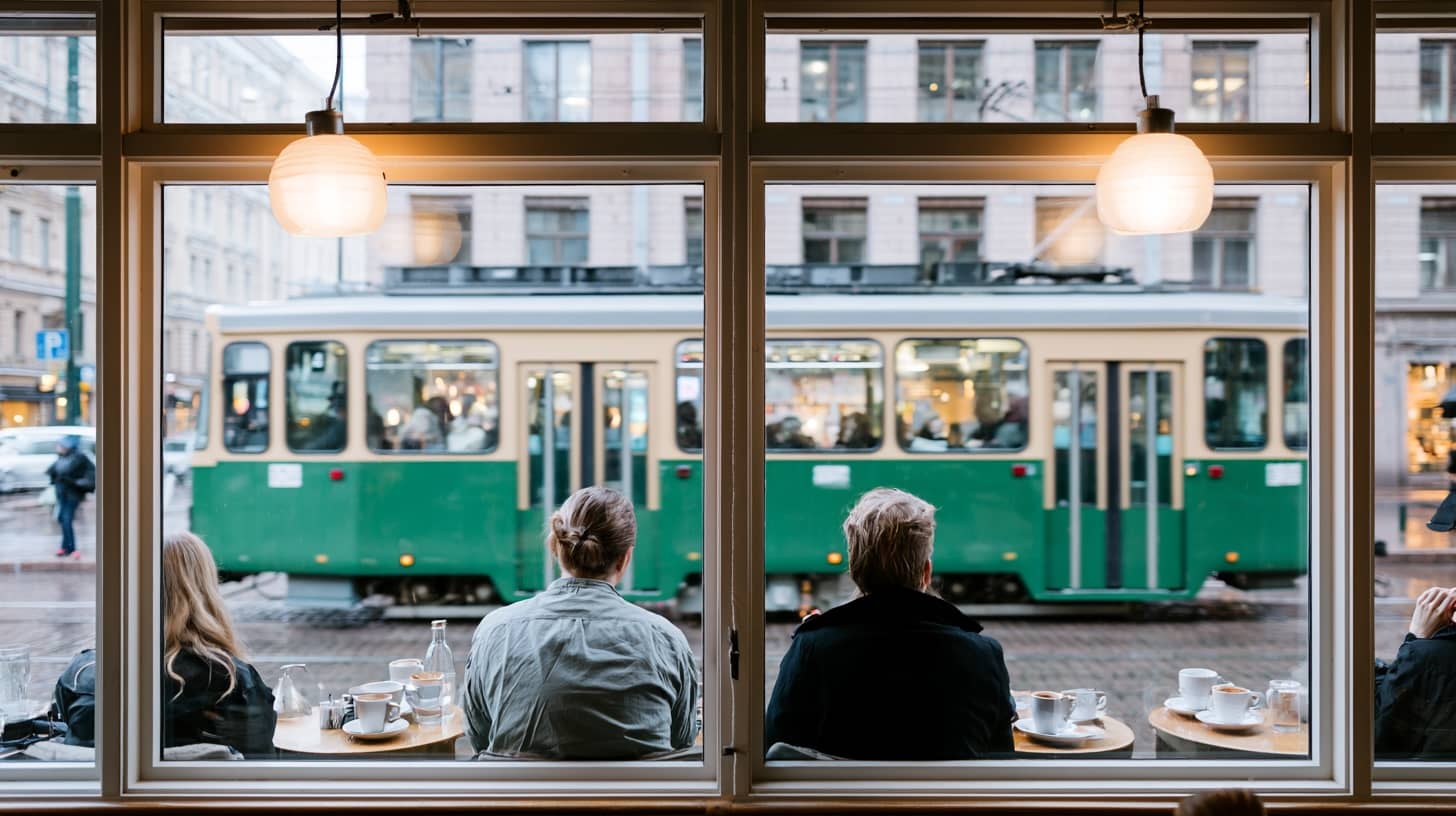
The mistake is to fight the weather. In Helsinki, a wet day is not a disruption so much as a cue: put the umbrella away, order something warm, and let the city come to you through a window.
Rain changes the tempo here in a way that feels almost generous. Streets soften, trams hiss past, and cafés start to look less like a stopgap and more like the main event.
Why a rainy day suits Helsinki so well
I like cities that know how to behave indoors, and Helsinki does this with particular grace. The architecture already encourages it: clean lines, practical layouts, generous windows, and public spaces that feel designed for lingering rather than performing.
That matters when the weather turns. A café is not just where you wait out the shower; it is where you notice the city’s taste for clarity, comfort, and a certain restrained elegance. Even the most casual espresso bar usually seems to understand the value of good light and a chair worth sitting in.
This is also a city where rainy-day planning feels refreshingly simple. You can move between coffee, museums, food halls, and short walks without needing to build a heroic itinerary. The point is not to cram in more, but to choose better.
Start with the cafés that can hold a whole afternoon
For a proper wet-weather base, I would begin with Kappeli in Esplanadi. It has the sort of old-world room that makes a rainy day feel deliberate rather than improvised, with a setting that suits coffee, lunch, or a second round when the sky refuses to improve.

Near the design district, Café Succès is a useful antidote to the over-styled café. It is more about doing the basics well: good coffee, something sweet, and a room where you can read, watch the door, and stay longer than you intended.
If I want a place with a stronger breakfast rhythm, I look to Way Bakery. It has the reassuring logic of a modern city bakery: baked goods, sandwiches, and coffee that support a slow morning without requiring a full lunch commitment.
There is also a pleasure in choosing a café that feels connected to Helsinki’s design culture rather than merely decorated with it. That is where the city becomes interesting on a wet day: not in spectacle, but in the subtle difference between a room that looks good online and one that actually helps you spend time well.
Know what kind of café day you want
Not all rainy days ask for the same thing. Some call for a quiet corner and a book; others are better spent with a pastry and a decent people-watching position. Helsinki gives you both, but it helps to choose your mood before you leave the hotel.
- For a long breakfast: choose a bakery-café with strong daylight and a menu that works from coffee to lunch.
- For a reading day: find a room with enough space between tables that you do not feel rushed.
- For people-watching: sit near the window in central cafés around Esplanadi, the Design District, or Kamppi.
- For a serious coffee stop: aim for places that treat the cup with some precision, not just decorative foam.
The best Helsinki cafés tend to be practical in the nicest way. You can arrive soaked, peel off layers, and settle in without theatrics. That is part of the charm: the room absorbs the inconvenience so you do not have to.
If you are staying centrally, this is also a city where a rainy afternoon can be planned almost entirely on foot. The distance between coffee and culture is short enough that you never need to overthink the logistics.
Pair your coffee with one museum, not five
Rainy-day perfection in Helsinki is a café combined with one good museum, not a marathon. I would rather spend an hour in a gallery and the rest of the afternoon at a table than hurry through three institutions with damp shoes and weak concentration.
Ateneum is an easy choice if you want a classic museum fix and a central location. It sits comfortably within a day built around coffee, and the surrounding streets make it simple to drift back toward a café when you are done.
For contemporary art, the Museum of Contemporary Art Kiasma gives you another useful indoor anchor. It is especially convenient when the weather is determined to be tedious, because you can move between art, tram stops, and coffee without any drama.
If you prefer a quieter sort of afternoon, the city’s museums can work as punctuation rather than the whole sentence. That, to me, is the Helsinki way: a thoughtful exhibition, then a good seat, then another cup.
Where the café scene feels most Helsinki
The Design District is the obvious place to start, though not because it is flashy. It is more useful than that, with cafés, independent shops, and a general sense that people here have already edited the excess out of the day.
Fazer Café is worth considering if you want a polished classic. It offers the kind of familiar polish that suits a rainy city break, especially when you want coffee with a pastry that feels unmistakably local rather than merely Scandinavian in the broadest sense.
Another dependable stop is Mokkamestarit, which appeals if you care more about the coffee itself than about the décor framing it. On a wet day, that can be exactly the right instinct.

Then there are the cafés that succeed because they understand rhythm. The room should let you arrive cold, warm up slowly, and decide whether you are staying for cake, lunch, or a second coffee. That practical hospitality is one of the city’s best habits.
Use the food halls when lunch becomes part of the plan
Rain tends to sharpen the appetite, and Helsinki has a neat answer to that: food halls. They are useful when you want lunch without the commitment of a full restaurant booking, and they make the city feel pleasantly navigable in bad weather.
Old Market Hall is the classic option. It has enough atmosphere to feel like part of the day, but enough practicality to keep things moving, with coffee, snacks, and proper lunch choices under one roof.
For something more contemporary, Forum Market can be a useful stop if your route runs through the centre. I would not plan a pilgrimage around it, but on a wet day convenience is a virtue, and Helsinki understands that better than most cities.
These places work because they reduce friction. No one wants to spend a rainy afternoon standing on the pavement choosing between cold hands and a bad sandwich. Indoors, with a table and a bowl of soup, the city seems immediately more generous.
What I would actually do on a wet Helsinki day
I would begin late, with a coffee and something baked rather than a rushed breakfast. Then I would pick one museum, ideally Ateneum or Kiasma depending on mood, and keep the rest of the day intentionally loose.
After that, I would walk through a central district in the rain just enough to enjoy the city’s architecture without overcommitting to it. The point is not to stay dry at all costs; it is to move between shelters in a way that keeps the day elegant.
By mid-afternoon, I would settle into another café, preferably one with a broad window and enough space to feel unhurried. If the weather improved, excellent. If not, Helsinki has already done the important work.
This is where the city can surprise people who expect rain to shrink a trip. It does the opposite. It creates a more disciplined version of sightseeing, where each stop has a clear purpose and no one needs to pretend that every hour must be filled with activity.
Practical tips for café-hopping in bad weather
The simplest advice is also the most useful: keep your route tight. Helsinki is very walkable, but a wet day is not the time to zigzag all over the map in search of a perfect espresso. Choose one district and let the weather determine your pace.
Trams are your friend when the rain becomes determined. If you are heading farther than you feel like walking, it is worth checking the route with the city’s public transport authority, HSL, before you head out. That small bit of planning saves a lot of wet waiting.
Also, do not underestimate coat management. Helsinki cafés can be stylish without being fussy, but wet outerwear takes up space and no one enjoys draping a dripping jacket over a neat chair. A compact umbrella and a tote that can hold layers are more valuable here than an elaborate travel wardrobe.
- Choose cafés near museums or food halls so your day flows indoors.
- Keep one flexible backup stop in case your first choice is full.
- Look for window seats if the rain is part of the pleasure rather than the problem.
- Favor places with a clear lunch offer if you plan to stay beyond one coffee.
If you need an indoor reset beyond coffee, Helsinki’s library culture is also worth remembering. The Oodi Library is not a café, of course, but it is exactly the sort of public space that makes a rainy afternoon feel more thoughtful than trapped.
Where rain makes the city look its best
Some cities try to be all sparkle when the sun comes out; Helsinki seems most composed when the light is soft and the sidewalks shine a little. Rain makes the architecture easier to read, especially around the centre, where clean forms and glass façades pick up the weather instead of resisting it.
That is why cafés matter so much here. They give shape to a day that might otherwise drift into passivity, and they do it without demanding that you perform enthusiasm. A good chair, a decent cup, and a view of trams through wet glass are enough.
I think that is the real appeal of rainy Helsinki: it does not insist on being conquered. It asks you to slow down, look properly, and let the day be smaller in the best possible way. For an adult traveler, that can feel like a relief.
So when the forecast turns grey, I would not cancel the plan. I would make the café the plan, and let the rest of the city arrange itself around it.