The mistake is assuming you need to join the bike-lane economy to enjoy Copenhagen properly. You do not. What you do need is to stop treating the city like a checklist of far-flung sights and start moving through it with a bit of common sense.
That means taking the Metro when the weather turns sharp, using the S-train when the city’s edges make sense, and relying on your own two feet when a neighbourhood deserves a proper look. It also means leaving room for cafés, museums, and the occasional sit-down by the water, which in Copenhagen feels less like a treat than a sensible way to travel.
Why skipping the bike can actually improve the trip
Cycling in Copenhagen is efficient, yes, but efficiency is not the same thing as pleasure. If you are new to the city, sharing space with locals who treat a signal change like a competitive sport can be more nerve than charm. Walking and transit give you time to notice the things bikes tend to flatten into background.
The city is compact enough that you rarely need to cross it in a heroic dash. Most central districts are well connected, and several of the best places for a first or second day sit close to stations, bridges, or water buses. The result is a trip that feels less like commuting and more like moving deliberately.
This matters in a city where the pleasures are often small and cumulative: a bakery queue, a clean-lined museum, a harbour edge, a square with actual benches. When you are not preoccupied with locking up a bike every hour, you start seeing Copenhagen at the pace it prefers.
Start with the Metro, not with the rental bike desk
Copenhagen’s Metro is the obvious answer for anyone staying central. It is fast, frequent, and mercifully easy to understand after a long flight or a late arrival. The lines connect key areas such as the airport, the old centre, Nørreport, Kongens Nytorv, and the newer districts without requiring a transport degree.
If you only memorise one station, make it Nørreport. It is the kind of practical pivot point that saves a trip: close to Torvehallerne food hall, the Latin Quarter, Rosenborg Castle, and easy onward access to elsewhere. Kongens Nytorv is another useful stop when you want to reach Nyhavn, the waterfront, or the museum-heavy part of town without fuss.
For official route planning, I use the DSB system information and the Metro’s own guidance when I want to double-check connections. You do not need to over-engineer it; in Copenhagen, transit is usually more straightforward than your phone battery will be by mid-afternoon.
Walk the centre properly, then stop pretending you are in a hurry
Indre By is where walking makes the most sense. The centre is made for measured wandering between squares, shopfronts, churches, and café tables, especially if you begin around Strøget and then drift toward quieter streets rather than staying on the most obvious axis.
I would not rush past the detail here. The Round Tower is an easy, practical stop if you want a view without scheduling an entire excursion. Nearby, the area around Trinitatis Kirke and the university streets offers a calmer version of the centre than the postcard zone around Nyhavn, which is worth seeing but not worth lingering over if it is shoulder-to-shoulder with visitors.
If your hotel is central, you can do a surprising amount on foot: breakfast, a museum, lunch, a second coffee, and a long detour that somehow becomes the best part of the day. The point is not to cover more ground. It is to avoid feeling like you are chasing the city around.
Use the harbour as a transport corridor
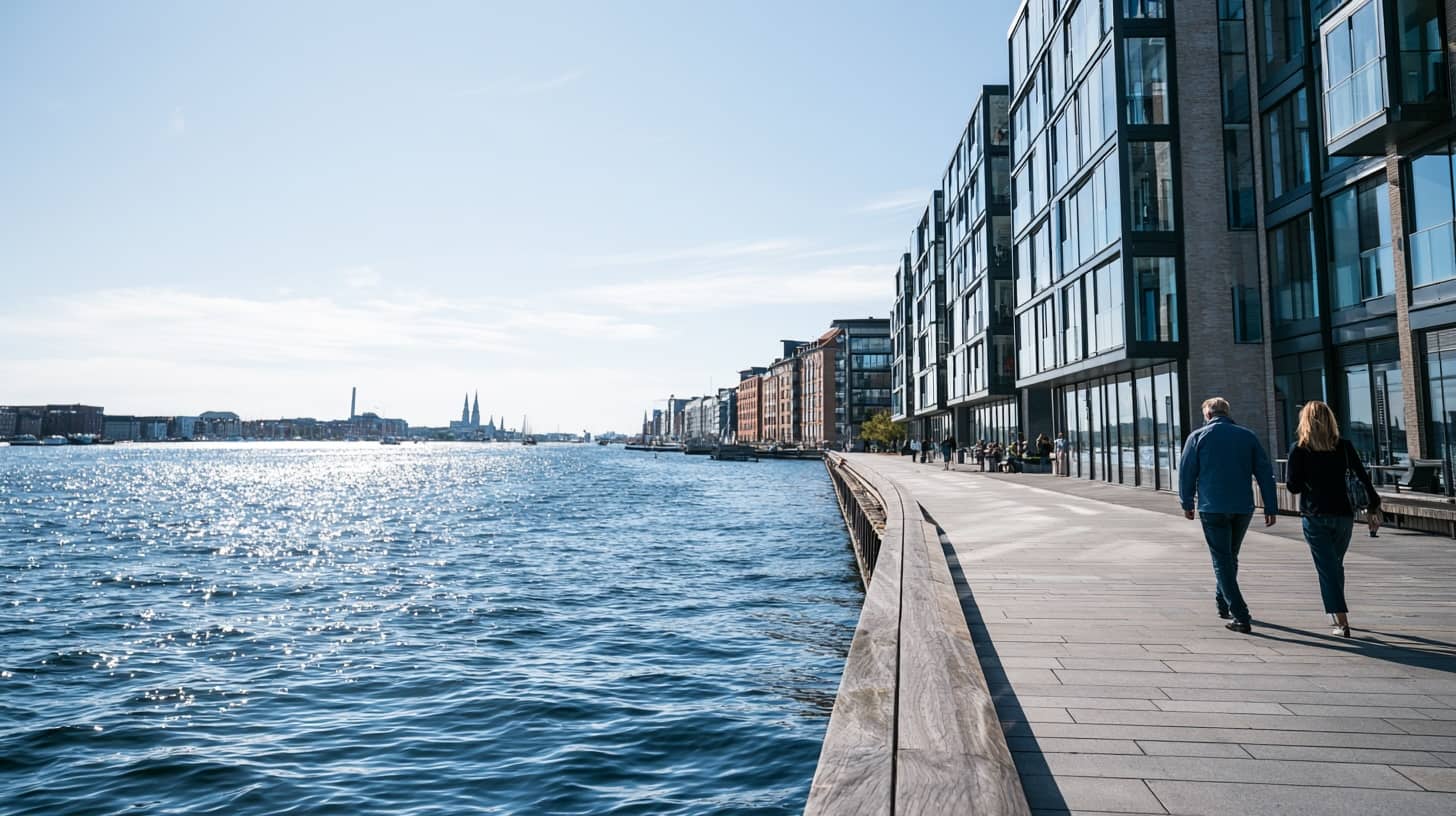
Copenhagen’s waterfront is not just decorative. It is one of the city’s best east-west routes, and it gives you a way to move between districts without any bike drama. Walking beside the water is especially useful when you want a clearer sense of how the city shifts from historic centre to newer development.

The stretch around Islands Brygge, the harbour baths, and the bridges toward Christianshavn rewards a slow pace. You can keep the water on one side and let the city reveal itself in layers: office buildings, apartment blocks, old warehouses, occasional swimmers, and the kind of people who appear to have planned their lunch break with unusual care.
When you want a more efficient crossing, the harbour buses are practical and slightly underrated. They are not a sightseeing gimmick; they are a clean, useful way to glide between points on the water while avoiding a longer land detour. If you are the sort of traveller who likes transit that feels mildly smug, this will suit you.
Base yourself where transit and walking both work
Accommodation matters more when you are not using a bike as your default solution. A good base in Copenhagen should put a station, a decent café, and at least one place you want to revisit within easy reach. That usually means central districts, or areas with a strong transit node and enough on the ground to make evenings easy.
Near Nørreport, you get the most straightforward logistics for a short stay. Around Kongens Nytorv, you are closer to the grander end of the centre and well placed for both walking and Metro access. Vesterbro is a smart option if you want a slightly looser atmosphere, plus easy access to the central station and a better chance of stumbling into a good dinner without planning too hard.
If you are choosing where to stay in Copenhagen without relying on a bike, I would prioritise proximity to a Metro stop over a postcard address. A pretty street is lovely. Being able to reach it, leave it, and return to it without wrestling with logistics is better.
Choose neighbourhoods that reward slow movement
Not every part of Copenhagen needs the same transport strategy. Some areas are better for extended walking and café stops, while others are easier to sample by Metro, train, or ferry and then explore on foot in a tight loop. That balance is what keeps the trip from becoming tiresome.
Nørrebro is one of the easiest districts to handle without a bike, especially if you like shops, bakeries, and a more lived-in atmosphere. Start near Assistens Cemetery if you want a quieter route, then drift toward Jægersborggade for food, coffee, and the sort of street where lingering feels natural rather than performative.
Christianshavn works well if you are happy to walk and cross water a little. The canals, low-rise streets, and proximity to the centre make it one of the more satisfying areas for a half-day. If you continue to Refshaleøen, you may decide transit is the better option for the return leg, which is exactly the kind of honest travel judgement I respect.
Frederiksberg is a little more polished and a little less straightforward, but it is still easy enough to manage without cycling. The city’s own metro lines and broad pavements help, and the area around the gardens and residential streets is ideal for a slower, elegant afternoon.
Let museums do some of the work for you
One of the best arguments for staying off a bike is that Copenhagen has a strong museum habit, and museums are naturally anti-bike in the middle of a day. They break up the pace, provide shelter when the weather changes, and give you a reason to sit down somewhere proper instead of treating the city like a racecourse.
The Ny Carlsberg Glyptotek is ideal when you want culture without too much friction. It is central, easy to reach, and generous enough in atmosphere to justify a slower visit. Nearby, the National Museum offers a broader historical sweep if you want context rather than just beauty.
For architecture-minded travellers, the David Collection and the Danish Architecture Center are both good fits for a city trip built around walking and transit. The point is not to tick off institutions. It is to use them as elegant pauses between neighbourhoods.
Make food stops part of the route, not an afterthought
When you are not biking everywhere, meals become better timed. You can stop at Torvehallerne for a market lunch without worrying about storage, helmet hair, or where to stash your bag while you eat. The hall is easy to fold into a morning around Nørreport or a lazy centre crawl.
For breakfast or coffee, look for places that tolerate lingering rather than rushing you onward. Copenhagen is full of cafés that understand the value of a second cup and a seat by the window. That is useful if you want to reset between museums and neighbourhood walks, which I generally do.
Lunch in this city works best when it is treated as part of the itinerary. A smørrebrød stop, a bakery counter, or a market hall plate can fill the gap between two walking areas nicely. It also saves you from the absurd idea that every day must be built around a reservation.
Use ferries, bridges, and short hops with confidence
If you are willing to think slightly laterally, Copenhagen becomes much easier. The harbour buses, bridges, and train links are more than backup plans; they are part of the city’s daily rhythm. A short ferry hop can be more pleasant than a long transfer on foot, especially if the weather is fickle.
Some journeys are simply better done as a short hop followed by a walk. For example, you might take transit toward Christianshavn, cross on foot, then continue into the centre or toward the water. The same logic works in reverse when you want to finish the day somewhere less central and return without plotting a cycle route in your head.
This approach also helps with energy management. Copenhagen is easy to enjoy when you avoid the trap of trying to “cover” it. A transit-assisted day often leaves more room for the things people actually remember: a view over the harbour, a good museum room, a neighbourhood street with useful shops, and a dinner that does not feel like recovery.
A practical way to plan a bike-free day
If I were building a sensible Copenhagen day without a bike, I would keep the structure loose but not lazy. Start near a Metro stop, walk one compact district well, break for coffee or lunch, then move to a second area by train, ferry, or on foot depending on distance.
Here is the kind of rhythm that works without becoming precious:
- Morning coffee near Nørreport or in the Latin Quarter
- A museum visit before noon, while your attention is still cooperative
- Lunch at Torvehallerne or another central stop
- A walk through Christianshavn, Indre By, or Frederiksberg
- One final transit-assisted hop to dinner or a waterfront drink
The key is to avoid stacking too many districts into one day. Copenhagen is compact, but it is not imaginary. If you try to do everything on foot with no planning at all, you will spend too much time in transit and not enough in the city itself.
What I would not bother with
I would not rent a bike for a one- or two-day trip unless cycling already feels natural to you in dense urban traffic. I would also not try to ride everywhere just because other people do. In Copenhagen, that is often a case of copying the local habit without adopting the local confidence.
I would not schedule the day around large distances either. Refshaleøen, for example, is absolutely worth seeing for selected food, design, or waterfront reasons, but it is best handled with a realistic transport plan rather than a vague promise to “just walk it.” The same goes for any itinerary that keeps bouncing between districts without pause.
What works better is a calm, practical pattern: Metro into the centre, walk where the streets are interesting, use the harbour or train when the gap makes no sense on foot, and allow café time to prevent the whole trip from turning into logistics homework.
Why the city opens up when you slow down
Without a bike, Copenhagen becomes less about speed and more about sequence. You notice how neatly the centre connects to its edges, how easily a museum leads to a square, how a canal can make a route feel longer in the best way, and how often the right answer is simply to sit for ten minutes.
That is the real advantage of not renting a bike everywhere. You stop measuring the city by distance covered and start measuring it by the quality of the hours. For a place as orderly as this one, that is often the smarter way in.
And yes, the cyclists will keep moving past you with unnerving confidence. Let them. You have a better plan.