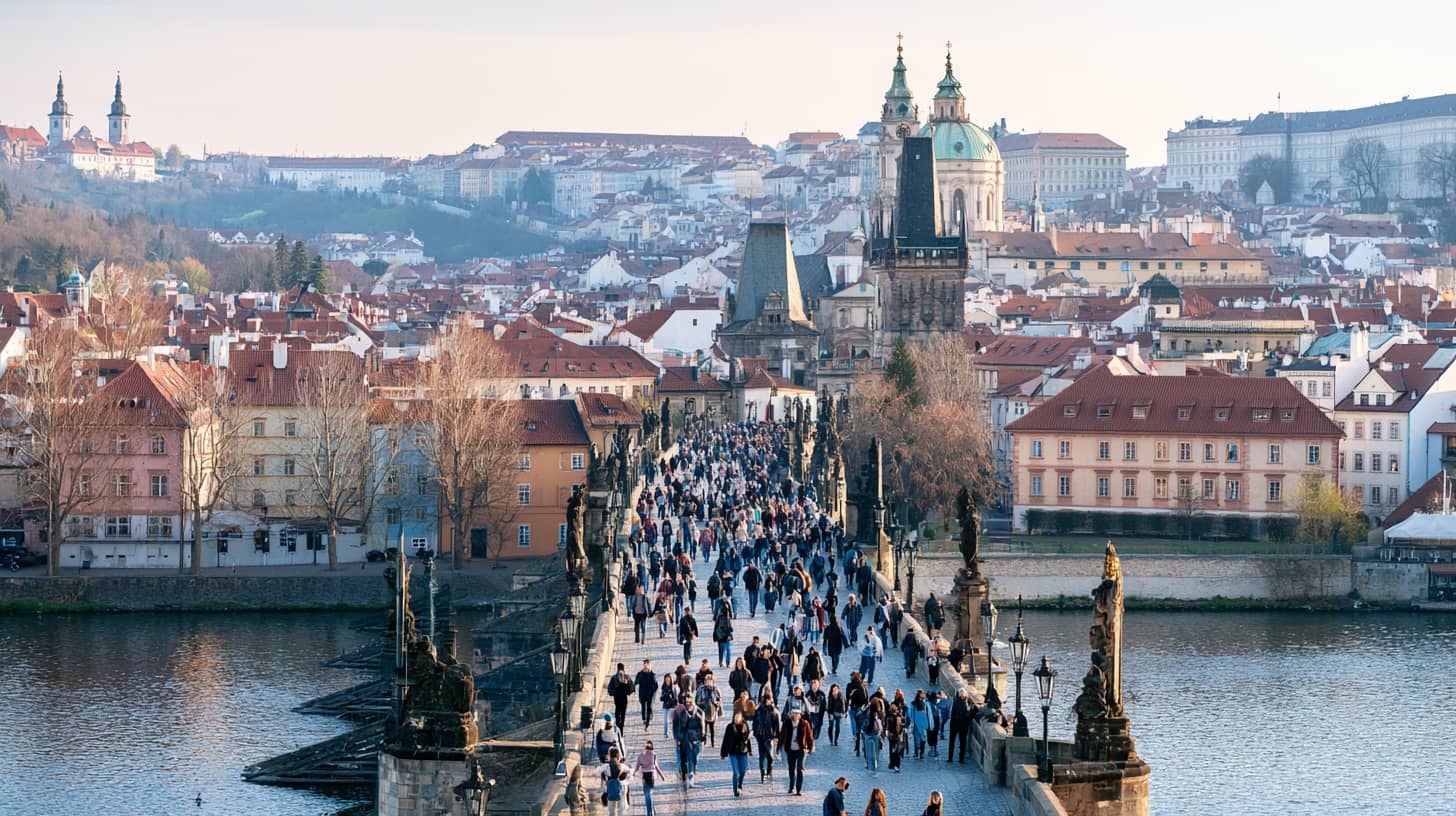
The trick in Prague is not to chase the cheapest bed on the map and then spend half your holiday commuting across bridges. In April, that trade-off gets even worse, because the city starts to wake up, sidewalks fill, and being central suddenly feels less like a luxury than basic common sense.
I would book with one clear idea in mind: stay close enough to walk to dinner, coffee, museums, and the river without negotiating with trams after dark. April is the month when Prague is at its most manageable for that kind of trip. The air is fresh, the crowds are lighter than in summer, and the historic core is still pleasant enough to cross on foot without feeling like you have wandered into a theme park with better architecture.
Why April changes the lodging equation
Prague in April is not yet trying to impress anyone with full summer drama. That is the point. You get enough daylight to roam, but not so much heat or crowd pressure that you need to hide indoors by lunchtime.
This is when central districts make the most sense. Walking between breakfast, a gallery, and an early dinner is easy, and you are less likely to resent the city’s size. The old centre is compact, but Prague is still a place where a bad hotel location can quietly eat your whole day.
What I like about April is the balance: hotel prices are often less punishing than in peak season, but the city is already active again. Cafés are open, terraces begin to matter, and places like Charles Bridge, Old Town Square, and the riverfront are lively without being intolerable.
Where to stay if you want to walk everywhere
If you want the simplest answer, stay in or near Old Town, Malá Strana, or the edge of New Town. Those are the areas that keep you close to Prague’s main sights while still making room for ordinary life: a bakery, a tram stop, a pharmacy, a decent wine bar.
Old Town is the obvious choice for first-timers, but it comes with a warning label. It is extremely convenient and occasionally annoying in equal measure. Pick it if you want to step out and immediately have the Astronomical Clock, Jewish Quarter, and river crossings within easy reach. Just choose a side street, not a square-facing hotel that pays for the view by making you listen to it all night.
Malá Strana is my favourite compromise for April. It gives you the castle backdrop and elegant streets, but it feels calmer once the day-trippers thin out. You are also well placed for dawn walks across Charles Bridge, which is one of the few times I would encourage anyone to be sentimental in Prague.
New Town works well if you prefer a more practical base. Around Wenceslas Square and down toward Národní třída, you get easy transit, good restaurant access, and a slightly less polished atmosphere that can be refreshing, especially if you like an early café stop. It is not the prettiest version of Prague, but it is often the easiest one to live in for a few days.
Old Town: convenient, central, and not always calm
Old Town is where many visitors want to be, and I understand why. You can reach the main historic sites on foot, and in April the weather usually makes that a pleasure rather than a chore. The problem is that “central” here can tip into “overly central” very quickly.
If you stay in this area, I would look for a hotel on a quieter street between the major landmarks rather than on the most obvious postcard corners. That gives you fast access to the square, the river, and the Jewish Quarter, without forcing you to live inside a souvenir shop corridor.
Old Town also makes life easier if your trip is short. A two-night stay in Prague should probably prioritise location over design theatrics. A solid room near Staroměstská or within a short walk of the river will save you more effort than a slightly cheaper place farther out.
For food and café hopping, the central grid works nicely. You can start with a slow breakfast, wander to the National Museum later in the day if the weather turns, and still make it back to your room without thinking about transport twice.
Malá Strana: quieter nights, prettier mornings
Malá Strana is the district I would choose if I wanted Prague to feel composed rather than frantic. The streets are beautiful in a restrained, stone-and-stucco way, and April suits that mood perfectly. It is one of the best areas for travellers who care about walking first and logistics second.

It also keeps you close to the castle without forcing you to sleep up in the tourist stream. Early mornings are the reward here. Before the groups arrive, the lanes below Prague Castle and the approach to the river can feel almost private.
There are practical advantages too. You are well placed for tram lines, easy access to the Lesser Town side of the river, and straightforward walks to Kampa Island or across to the Old Town. At night, it tends to be more civilised than central Old Town, which matters if you like to return from dinner without a soundtrack.
If you are choosing a hotel here, I would favour character over size. Small design hotels and townhouse conversions suit the area, and the streets are more rewarding when your base feels like part of the neighbourhood rather than a generic room with a view of something famous.
New Town and the easy access option
New Town is the practical answer for travellers who want central Prague without paying for maximum romance. It is especially sensible in April, when you may be out all day and only need your hotel to function well, rather than dazzle you from the lobby.
The main appeal is movement. From here, it is straightforward to get around by tram or on foot, and you can reach the river, the National Theatre, the museum end of Wenceslas Square, and a decent spread of bars and restaurants without complicated planning. I always think this matters more than people admit.
This area also suits travellers who want a slightly broader version of the city. You are still central, but less sealed inside the historic core. That can be useful if you like the contrast between grand façades and the daily life of cafés, offices, and apartment buildings that actually function year-round.
If you are staying only briefly, look for somewhere near Národní třída, Můstek, or the edge of Karlovo náměstí. These are strong practical bases, especially if your idea of a good trip includes an afternoon museum, a pause for coffee, and the option to wander home without checking a map every ten minutes.
What central Prague gives you in April
April is a sensible month for museums, river walks, and flexible days. You are less likely to be defeated by weather, but not yet tempted into the full laziness of summer. That makes central lodging more valuable, because you can improvise without losing time.
Start with the basics: Charles Bridge, Old Town Square, the Jewish Quarter, and the route down toward the river. Then let the rest of the day unfold around whatever the weather allows. If it turns grey, a museum makes sense. If the light is good, walk to Kampa or up to the castle slopes. If the sky is indecisive, take another coffee and wait it out like a reasonable adult.

For art and history, the city is unusually cooperative. The Czech National Library is not the only reason to stay central, of course, but the broader point is that being near the core puts a long list of options within easy reach. You are not planning around transport so much as around appetite.
That is exactly what makes April the sweet spot. You can still enjoy Prague’s big names, but you are also less likely to feel trapped by them. Central accommodation lets you move in and out of the city’s busiest zones before they become tiring.
Hotels I would prioritise for this season
In April, I would favour hotels that are genuinely walkable, properly insulated from street noise, and good at breakfast. Prague is not short of beautiful buildings converted into hotels, but you still need a room that works when the weather is changeable and you want a soft landing between outings.
Look for smaller design hotels, heritage properties, or well-run business hotels in central districts. The important thing is not the category but the behaviour: good windows, sensible heating, reliable Wi-Fi, and a location that keeps you from relying on taxis for every move.
A few practical filters help. If the property is in Old Town, check the exact street and whether it faces a square or a quieter lane. If it is in Malá Strana, make sure you understand the hill situation. If it is in New Town, confirm that the nearest tram stop actually matters, rather than merely existing in theory.
- Choose a hotel within walking distance of a tram or metro stop, even if you plan to walk most places.
- Prioritise soundproofing over flashy design if you are staying in Old Town.
- Book breakfast only if it is genuinely good; Prague cafés are a better use of money when they are.
- For a short trip, staying central is usually worth the premium.
- If you want quieter nights, choose Malá Strana or the edge of New Town over the most obvious Old Town addresses.
Getting around without overthinking it
Central Prague is very walkable, but not every route is equally kind. April weather can shift quickly, so I would treat transport as a backup rather than the main event. Trams are useful, especially if you want to avoid a hilly walk after dinner or when the temperature drops in the evening.
If you stay in the centre, the city becomes pleasantly legible. You can cross from Old Town to Malá Strana, take a tram when you are tired, and still end up feeling that you have spent most of the day moving on your own terms. That matters more than having the cheapest possible room outside the centre and a mental spreadsheet of transit connections.
For anyone with limited time, being central also reduces decision fatigue. You can return to your hotel between sights, drop off a coat, and head back out. In April, when you may dress for three seasons before lunch, that convenience is worth real money.
If you want official transport information, the Prague Public Transit Company is the place to check tickets, routes, and service updates before you set out.
My practical April checklist
There is a simple way to think about Prague accommodation in April: pay for position, not for a fantasy. A central base will let you adapt to weather, daylight, and appetite without much effort. The city is compact enough that this pays off every single day.
I would especially recommend central lodging if you are planning museum time, a couple of nice dinners, and unhurried walks. April is one of the best months to enjoy Prague without the pressure of peak-season crowds, and staying near the centre lets you use that advantage properly.
If I were choosing now, I would lean in this order: Malá Strana for calm and elegance, New Town for easy function, Old Town for maximum convenience. That is not a moral ranking. It is simply the most efficient way to make Prague feel easy in a month when the weather is soft, the city is active again, and your hotel location can either help or quietly annoy you.
So yes, stay central. In April, Prague is at its best when you can leave your room, cross a beautiful street, and already be halfway to your first coffee.