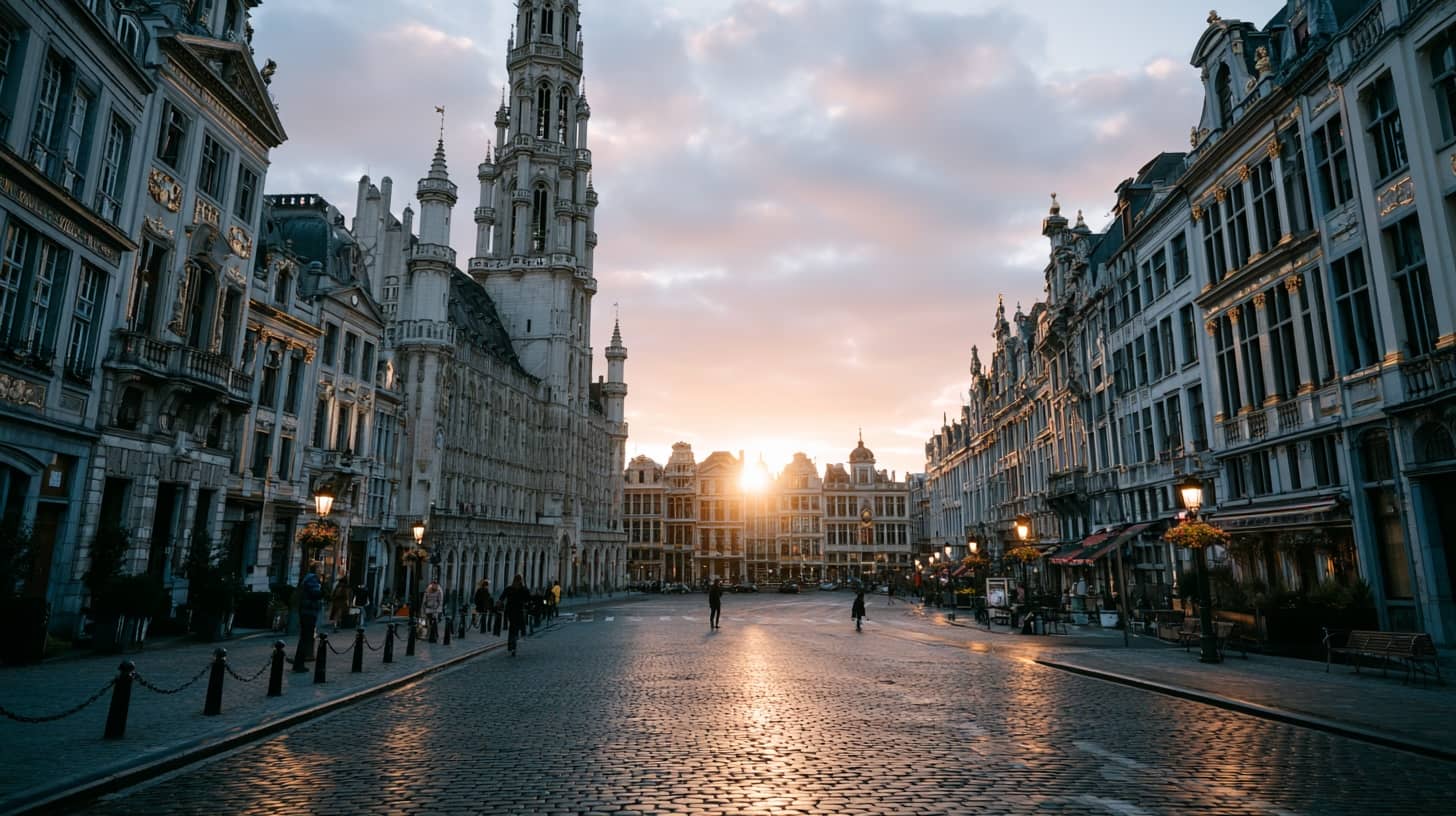
Go to Grand Place for daylight, not dinner. The square is still handsome after dark, but evening turns it into a place you photograph and leave, while the better meal of the day happens a few streets away, where the tables feel less staged and the margin for disappointment is smaller.
That is the useful Brussels answer: see the gilded façades while the stone still catches the light, then eat and drink elsewhere. If you build the day this way, you avoid the expensive, generic feeling that can creep in around the square after office hours, and you keep the city centre pleasantly walkable rather than performative.
Start with the square before the shutters close
Grand Place works best when the city is fully awake. The guildhouses are easier to read in daylight, the gilding has some warmth to it, and the square feels like an urban room rather than a backdrop. By late afternoon, especially in shoulder-season light, the detail still holds; by dinner, you are mostly paying for proximity to the postcard.
So begin there, but do not linger over lunch just because you are in the centre of things. The better move is to treat Grand Place as the opening scene, then use the surrounding lanes as the place where the day becomes more practical. Rue des Bouchers is the obvious funnel, but it is not where I would steer a grown-up meal if there is any flexibility at all.
If you want a better visual circuit, walk from Grand Place toward the Royal Gallery of Saint Hubert and keep going until the crowds thin. The gallery gives you the classic covered passage without forcing you to sit still for too long, and it connects neatly to the kind of centre-city wandering Brussels does well: short distances, mixed architecture, and just enough variety to keep you moving.
Eat before the evening turns the centre into a trap
For dinner, stay within the central loop but be picky. Where to eat in Brussels can change quickly depending on the hour, and the best strategy is usually to step one or two streets away from the square rather than chase the closest menu board with the biggest photographs.
La Pierre Bleue is the kind of room that makes sense here: central, but not theatrically so, with enough substance to justify sitting down before the evening rush gets silly. It is the sort of place that fits a day built around Grand Place without pretending the square itself is where dinner should happen.
If you want something a little more robust and are happy to keep the walk modest, RAMBO Ste-Catherine near Place Sainte-Catherine gives you another sensible option. It is close enough to fold into a central evening, but far enough from the square to feel like you have chosen a neighbourhood meal rather than accepted a tourist default. That matters more than it sounds.
For a bigger, more obviously indoor dinner with plenty of seating, Meat Factory Brussel on Borgwal works as a straightforward fallback when you want to avoid fuss. It is not the romantic answer, and that is precisely why it can be useful: if the weather turns, or the centre feels more crowded than charming, a place that handles volume without making you feel rushed is worth a lot.
Use Sainte-Catherine when you want the city to loosen up
Sainte-Catherine is one of the easiest places to redirect the evening without overthinking it. The square around Place Sainte-Catherine and the nearby streets keep you close to the centre while feeling less like you are standing in front of the city’s main display case. For a day that starts at Grand Place, that shift is healthy.
Poule & Poulette Brussel on Place Sainte-Catherine is a practical dinner choice if you want a lively room and no dramas about whether the table is too formal for a casual evening. It is also one of those places that works when you are travelling with other adults who do not all want the same level of seriousness from the meal. Brussels often asks you to choose between central and easy; this gets you both.
From there, you can drift toward Rue de Flandre or down to the canal side without any big decisions. The point is not to create a grand culinary pilgrimage. The point is to keep the evening useful: a decent meal, a short walk, then a drink somewhere that does not require you to keep your coat on until dessert.
Drink where the room feels more important than the postcode
After dinner, I would rather have one well-chosen drink than a sequence of places you only half like. For that, Pigeon Bar is the most literal answer to the square-to-night transition: it is central, it stays in the evening frame, and it gives you a neat place to sit with the day still close enough to talk about. If you are the type who wants to step out for “just one more” without it becoming a project, that is the sort of bar that helps.

For a more local-feeling turn, Nüetnigenough is useful when you want the evening to keep going without getting louder or shinier. It suits the old-centre part of Brussels that people often miss because they move too quickly from landmark to meal. This is the city’s practical advantage: you can go from a formal square to a low-key drink in a handful of minutes.
If you are heading south after sunset, Rosa Bar in Ixelles is the better choice for anyone who prefers the evening to loosen a bit. It is outside the immediate Grand Place orbit, so treat it as a deliberate move, not a casual extra. The reward is a room that feels built for lingering, which is exactly what the centre is not really designed to do.
Keep dessert simple and edible on the walk back
Brussels can be annoyingly good at desserts, which is why it is sensible not to plan them with too much solemnity. After dinner, a takeaway counter is often the smarter answer than another sit-down stop, especially if the weather is fine and you want to keep moving through the central streets instead of checking the bill again.
Gaston Sablon, on Place du Grand Sablon, is the most appealing option if you are already drifting south from the centre and want something sweet without changing the pace of the evening. The Sablon area gives you a different kind of finish from Grand Place: less ceremonial, more composed, and better suited to an after-dinner stroll than a second round of seating.
Closer to the square, La Maison des Gaufres is a straightforward choice when you want dessert without negotiation. It is the kind of stop that works for people who like the city centre to remain a walking route rather than a dining room. If you end up near the Galeries Royales Saint-Hubert again, the geometry of the evening still makes sense.
What to do if the weather turns
Rain changes Brussels in a useful way. It does not cancel the evening; it just punishes bad venue choice faster. If the forecast is ugly, keep the Grand Place visit earlier in the day and move quickly into covered passages, indoor rooms, and places that do not make you stand in the wet pretending it is charming.
That is when a rainy day in Brussels becomes the better guidebook logic: choose rooms with real seating, keep the walks short, and stop trying to make the square itself do all the work. If the weather is poor, the point is to stay comfortable and keep the evening moving without unnecessary detours.
Foor’n is slightly farther out, so I would not fold it into a Grand Place dinner unless you are already heading that way. But it is a useful lunch-or-evening meal option if your day widens beyond the centre and you want a place with ample indoor seating rather than a gamble. In Brussels, those practical details matter more than the décor review.
A better half-day rhythm than the obvious one
If you only have one compact stretch of time, use it like this: Grand Place in daylight, a slow walk through the Royal Gallery of Saint Hubert, dinner near Sainte-Catherine or Rue des Dominicains, then one drink in the centre if you still have energy. That sequence keeps the square in the story without making it the whole story.

It also solves the easy Brussels problem, which is not finding places but choosing the right hour for them. The centre looks best when it is still a place to stand and look up; later, it becomes a corridor between better rooms. Once you accept that, the evening gets simpler and cheaper, because you stop paying for front-row seats to a square that is already doing its job.
If you want the simplest version possible, make Grand Place your daylight stop, eat at La Pierre Bleue or RAMBO Ste-Catherine, and finish with a drink at Pigeon Bar or Nüetnigenough. That is enough structure to keep the day smooth, and not so much that you feel you have booked yourself into your own itinerary.
The preference, then, is plain: admire Grand Place when the light is kind, then get dinner somewhere with a real reason to exist after dark. Brussels is much easier when you let its centre be handsome, not overworked.