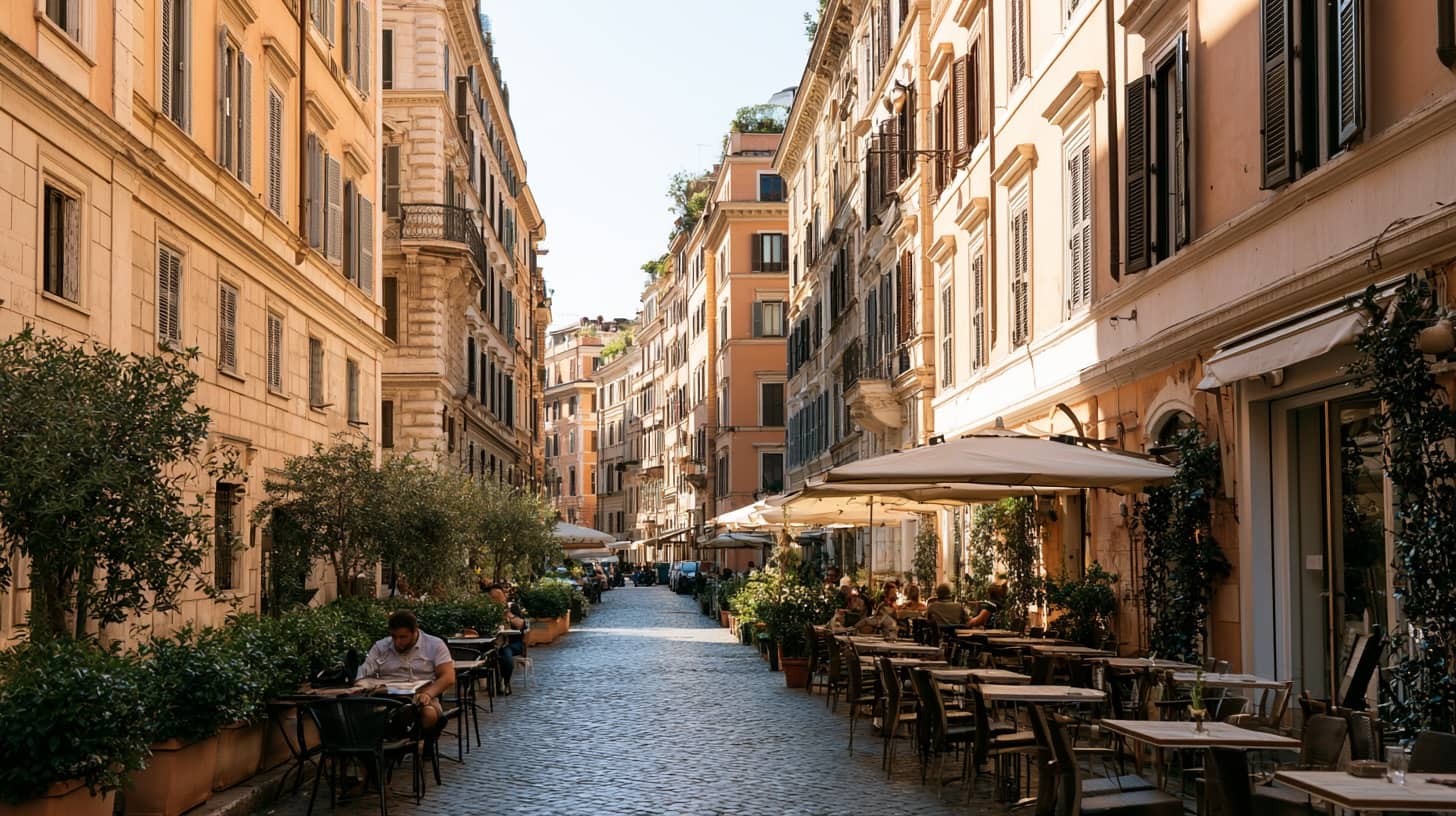
The common mistake in Monti is to treat it like a shortcut. People cross it on the way to the Colosseum, then wonder why it never quite comes into focus. Better to slow down on the streets just behind Via Cavour and let the neighbourhood reveal itself in smaller pieces: a bar counter, a bookshop window, a church façade, a street that turns unexpectedly quiet for Rome.
The stretch worth lingering on runs around Via dei Serpenti, Via Urbana, and Via Panisperna, with Piazza degli Zingari as a useful pause point. It is compact enough to read on foot, but not so compressed that every step feels staged. That matters in central Rome, where some districts are beautiful but worn thin by attention.
Start where Monti is least theatrical
Begin near the lower edge of the neighbourhood, around Via dei Serpenti and the approach from the Metro B stop at Cavour. The street is practical before it is picturesque, which is part of the appeal: there is no grand reveal, only a gradual thinning of traffic and a shift from through-route to lived-in street.
From there, the first read on the neighbourhood is architectural rather than social. Ochre façades, shutters, small balconies, and doorways built to swallow sound give the streets a calm that is easy to miss if you move too quickly. The blocks narrow just enough to soften the noise without draining the area of energy, which gives Monti its useful middle gear: central, but not frantic.
Keep your pace measured. This is not a district to power through with a map held high, and it is not improved by overplanning. If you want a reference point, Borri Books at Piazza dei Cinquecento is a sensible prelude or postscript on the edge of the area, especially if you are arriving by rail and want one more indoor stop before heading into the side streets.
Choose the streets with the best table spacing
What sets Monti apart is not only its old fabric, but the way some of its rooms open onto the street. In Rome, a good neighbourhood café is often less about espresso mythology than about whether the tables are set far enough apart to let you remain a person rather than a passer-through. That is one reason Via Urbana and Via Panisperna deserve time rather than a glance.
Bar Monti on Via Urbana is the obvious name in the immediate area, and it earns its place less for novelty than for being exactly the sort of room you want when you need to stop deciding and simply sit for a while. It suits an unhurried lunch or an early dinner before the neighbourhood fills up.
If you prefer something quieter and more contained, Cabaret Voltaire Roma on Via Panisperna offers enough indoor seating to make lingering sensible rather than indulgent. That kind of practical comfort matters on days when the weather is uncertain, or when you want to stay in the area without committing to another long walk.
Let the bookshop and the bar do the work
Monti rewards the person who is content to divide a day between reading, drinking, and watching the street rather than collecting sights in neat succession. A bookshop stop fits that rhythm well. Keep it for daylight; bookshops rarely improve after dinner, however charming the room.

For late afternoon or evening, the mood changes without requiring much movement. A bar counter or seated room is usually enough, as long as it lets you stay with the neighbourhood rather than pushing you back into motion. It works best as a pause, not as a destination in itself.
If you prefer a slightly more polished drink stop, Bo.no. – Monti on Via Cavour gives you a straightforward cocktail-and-wine room with the kind of indoor seating that makes it easy to stay through the first hour of the evening without checking your watch. The point is not to be hidden away; it is to have enough room to settle in.
Build the walk around one square, not a checklist
Piazza degli Zingari is a better place to orient yourself than many of the obvious names in central Rome because it offers a calmer reading of the neighbourhood. It is not grand, which is a benefit. You can stand there long enough to notice how people use the edges of a square when they are not rushing toward a monument.

From the piazza, the route toward Via Panisperna makes the strongest case for Monti as a place to linger. The street bends and tightens without losing dignity, and the cafés and restaurants here feel integrated into the residential grain rather than pasted on top of it. That is why the area works for adults who like being out without feeling required to entertain themselves every five minutes.
You can keep the walk deliberately short. One good loop is enough: Cavour to Via Urbana, a turn through Piazza degli Zingari, then along Via Panisperna before deciding whether to stop for lunch, a drink, or simply to head back toward the station or the Forum. The route is compact, but it does not feel stingy.
On a rainy day, Monti is better indoors than most people expect
Rain changes the neighbourhood in a useful way. The streets darken, the shop windows sharpen, and the case for staying local becomes stronger. This is where Monti’s rooms matter: a neighbourhood is often judged by what it offers when the weather is bad, not when the sky is flattering it.
For a seated café stop, Cabaret Voltaire Roma is the most comfortable fit among the named places here, while Bar Monti works when you want a shorter, more casual pause. The test is simple: if a place can absorb a few extra minutes without making you feel in the way, it belongs in the day.
For readers who want a quieter, more public setting, the Museo Nazionale Romano’s Palazzo Massimo and Diocletian complex is a sensible nearby extension, especially if the weather pushes you toward one longer indoor block. It is not in the middle of Monti’s lanes, but it is close enough to fit the same day without breaking the mood. If you are checking official details, use the museum’s own website rather than assuming the opening pattern will suit your timing.
Where to eat without leaving the neighbourhood’s scale
The best meals in this part of Rome are usually the ones that do not demand a detour to feel serious. Monti is not a district that improves when you overcomplicate it. A lunch or early dinner here should preserve the scale of the walk: central, yes, but not grandly logistical.
That is why al42 by Pasta Chef rione Monti makes sense inside the route. It is close enough to be easy, but not so performative that it drags attention away from the rest of the day. For something later in the evening, Bo.no. – Monti keeps the focus on drinks and a seated room, which is often exactly what you want after a slower neighbourhood circuit.
If you are planning the rest of the day around a museum visit or a train departure, this is also the point to be disciplined. Monti is best when you keep your food stop purposeful and resist the temptation to stretch lunch into a full afternoon of indecision. The neighbourhood is good at absorbing time, and that is partly why it deserves a little structure.
A practical way to spend half a day here
Start by arriving at Cavour or by walking down from the Esquilino side, then keep the route low-pressure and bounded. Make one slow circuit through Via dei Serpenti, Via Urbana, Piazza degli Zingari, and Via Panisperna. That is enough to give the neighbourhood shape without turning it into a project.
For coffee, choose a place that suits a short pause rather than a grand lingering session; for lingering, use a room with better seating. The distinction matters in Rome, where an espresso bar and a sit-down café can serve two very different kinds of afternoon.
If you are arriving after a museum morning or before dinner elsewhere, this stretch also works well as a decompression walk. It is central enough to fit easily between larger plans, but compact enough that you do not need to explain it to yourself as an “activity.” That is often the best sign.
Do not rush the last block
Monti’s most convincing moments are usually the ones that happen between obvious destinations. The last block before you turn back toward Cavour, the shadowed doorway on Via Panisperna, the square where people are not yet ready to leave, the table that still has room for one more hour: these are small details, but they are the details that make the neighbourhood worth a slower look.

So do not build this part of Rome around a grand plan. Build it around one calm route, one decent indoor stop, and one meal that does not force you to hurry. If the day ends with a drink at Antigallery or a last seated glass at Bo.no. – Monti, that is enough. Monti is at its best when you leave it by choice, not because you ran out of things to notice.