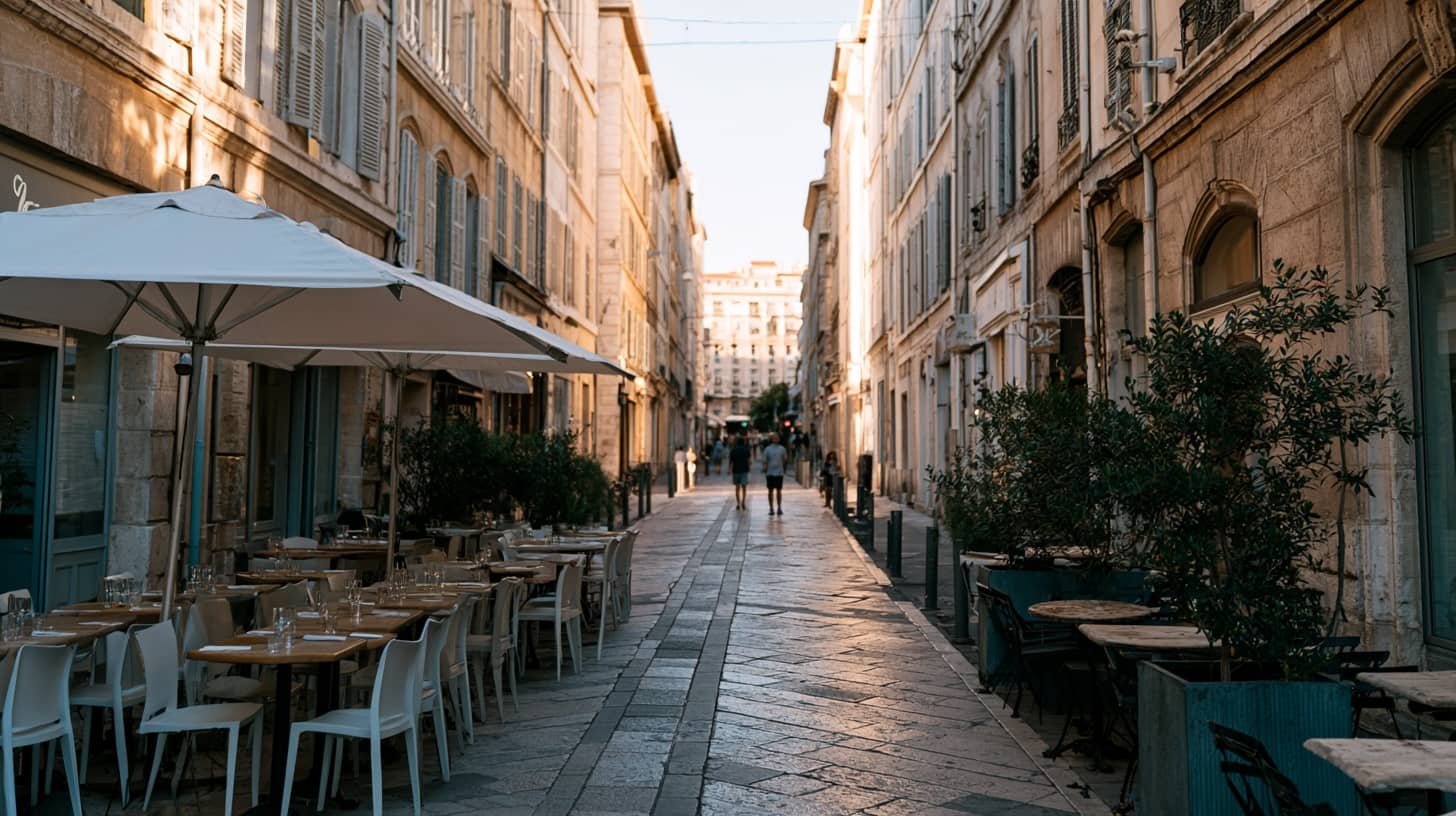
If you want Marseille without the full-volume port soundtrack, the trick is simple: stay a little inland from the Old Port, not miles away from it. Around La Mercerie, you can sleep in a calmer pocket and still walk to the parts of the city that actually make life easy: the métro, the shopping streets, the water, and a useful spread of cafés and bookshops.
This is not the part of town where you wake up to fishing boats and gulls directly below the window. That is the point. You keep the central location, but you dodge the kind of noise that turns a short city break into a daily negotiation. If you want the broader logic of staying a touch away from the obvious waterfront, another way to think about Marseille is to treat the centre as a set of walkable layers, not one single magnet.
Why La Mercerie works when you want calm without exile
La Mercerie sits in the practical middle of things. It is close enough to the Old Port that you do not need to plan your day around transport, but it is far enough from Quai des Belges that late-night spillover feels less invasive. That matters in Marseille, where one street can feel serene and the next can be all scooters, restaurant chatter, and people still lingering after dinner.
The area also rewards people who travel with a bit of common sense about mornings. You can start with coffee at Café Bovo on Rue Beauvau if you want to edge toward the old centre, or keep it more straightforward with Café De France near the rail side of town. If you are the type who likes a hotel base that makes the first move of the day painless, this part of town handles that nicely.
What makes it appealing is the lack of theatre. You do not need to work your way into the city. You are already in it, with Centre Bourse, La Canebière, and the metro doing the unglamorous work of making Marseille feel manageable.
The walk from La Mercerie to the Old Port is short, but it changes the day
In Marseille, distance is not just distance. A ten-minute walk can take you from quieter streets to the full visual economy of the Vieux Port: ferries, masts, fish stalls, cafés, and the wide sweep of the water. From La Mercerie, that shift is simple enough to use several times a day without feeling as if you have committed to a trek.

For a base, that means you can head out early before the port gets crowded, come back for a break, and return later without losing half an hour to transit. The most useful part of the map is not romantic at all: it is the strip around La Canebière, Rue Sainte, and Quai des Belges, where you can move between errands, meals, and evening plans without overthinking the geography.
If you enjoy a city that gives you options rather than forcing a single mood, this is the sensible end of Marseille. You can head toward the water when you want spectacle, or stay in the denser street grid when you want the day to feel ordered. That flexibility matters once the first impression has worn off.
A good morning here starts with one decision, not five
One of the quiet pleasures of a central base is that breakfast does not need to become a project. If you want a proper sit-down start, 1860 Le Palais on La Canebière is a reasonable choice because it has ample indoor seating and works when you want to sit down before the city fully wakes up. It is not a place for drama; it is a place for getting on with the day.

If you prefer your morning to be lighter and faster, the takeaway counter setup at 7VB Café in the Vieux Port area makes more sense. It is useful when the plan is to leave, walk, and keep moving. For a slower pause later in the day, Black Bird Coffee on Cours Julien gives you a different side of Marseille altogether, one that feels more creative and less port-facing without making you travel far.
The practical point is this: a central base should reduce the number of decisions before noon. La Mercerie helps because you can choose between a sit-down breakfast, a takeaway coffee, or simply leaving the hotel and deciding after five minutes on foot. That sounds minor until you have spent a week in a place where every errand starts with a bus ride.
Lunch, dinner, and the question of whether you want to stay put
For meals, the advantage of this part of Marseille is choice without sprawl. Cantoche on Rue Haxo is close enough to feel like a local default, and it suits a day when you do not want to build your afternoon around a reservation hunt. If you want something a little more polished but still central, À Moro on Rue Venture is a solid direction for lunch or dinner without making you wander far from the base.
When the evening needs a bigger, more deliberate meal, Chez Nous around Place Notre Dame du Mont gives you a reason to head slightly uphill into an area that stays practical but feels less tied to the port. That kind of detour can be worth it when you want a dinner that feels a bit more like an occasion. It is a deliberate choice, not an automatic one, which is often how good travel evenings work.
The central advantage here is not that every meal is a knockout. It is that you can choose based on energy. Low-energy night? Stay close. Higher-energy night? Walk a little farther. Marseille works best when your base lets you match the meal to the mood instead of forcing the reverse.
A rainy day does not become a wasted day
Central Marseille is better protected from bad weather than people expect, partly because there are enough indoor places to turn a damp morning into a productive one. Fnac at Centre Bourse is the obvious fallback, but if you want something that feels more independent, Gibert Joseph Marseille on Bd Dugommier and Grande librairie internationale de Marseille on Rue Vincent Scotto are both useful for a slow browse. They are close enough to fold into a half-hour gap between showers.
For coffee with a bit more room, Exit Café on Quai de Rive Neuve and Ben Mouture in the Petit Chantier area are both practical indoor stops. The appeal is not that they are famous; it is that they solve the basic problem of wet weather without turning your day into a search mission. That is worth something in a city where a sudden wind can arrive before lunch and stay until dusk.
If you prefer a drink rather than another coffee, Bar Berti on Rue Nationale is a straightforward evening option when you want to stay dry and keep the night uncomplicated. It is exactly the sort of place that makes a central base feel like convenience rather than compromise.
The streets that make the location work
When you are choosing a base, streets matter more than neighbourhood labels. La Canebière gives you the obvious axis, but Rue Venture and Rue Haxo are the quieter, more functional ones to keep in mind because they sit just far enough off the main drag to feel easier at night. Rue Sainte also matters because it links you toward the port without the sense that you have entered a tourist corridor every time you leave the building.
From here, you can also use the metro without fuss. The lines around Vieux-Port and Noailles turn the city from a walk-only proposition into something broader, especially if you are heading to the rail station or want to duck across town without eating up the whole afternoon. That matters for travellers who like to be central but not trapped inside a five-block comfort zone.
The broader lesson is that a good Marseille base should not make you think about transport every time you go out. La Mercerie does the opposite: it lets you keep transport in reserve, which is a much better feeling than needing it for every minor plan.
How I would choose a base here if I were booking blind
If your priority is sleeping well and still getting around on foot, I would keep the search centred on the La Mercerie pocket, then compare it with a slightly livelier edge near La Canebière or Rue Sainte. That is the difference between “central” as a technical claim and central as something you actually feel when you come back late with tired feet.
For travellers who want the city to start at the door, the Old Port itself is probably too noisy and too exposed to be the first choice. You will be paying for the view and accepting the trade-offs. Around La Mercerie, you keep the useful parts of the centre without inheriting the whole waterfront’s personality.

If you like to build a day around a bookshop, a coffee, and one deliberate dinner, this is the right kind of base. You can do the practical loop in the morning, move toward the port later, and come back without feeling as if you have crossed the city. That is the kind of convenience that usually disappears once you name it, so the safest move is to keep it simple.
My honest pick
For most adult travellers, I would choose this part of Marseille over the more obvious waterfront stays. It is calmer, more usable, and better suited to a trip where you want to walk, eat well, and sleep without being jolted awake by the port’s social schedule.
Stay near La Mercerie if you want the centre without the excess noise, then build your days outward: breakfast on La Canebière, lunch on Rue Haxo or Rue Venture, a browse at Gibert Joseph Marseille, and an evening drink at Bar Berti if you want something easy and indoors. That gives you the city in manageable pieces, which is usually the smartest way to book Marseille in the first place.